Your history. Your inbox.
7 uniquely curated newsletters to choose from.


This lesson is part of the Investigating the Histories of Women / Conjuguer nos histoires au féminin collection and is suitable for grade 10 to 12.
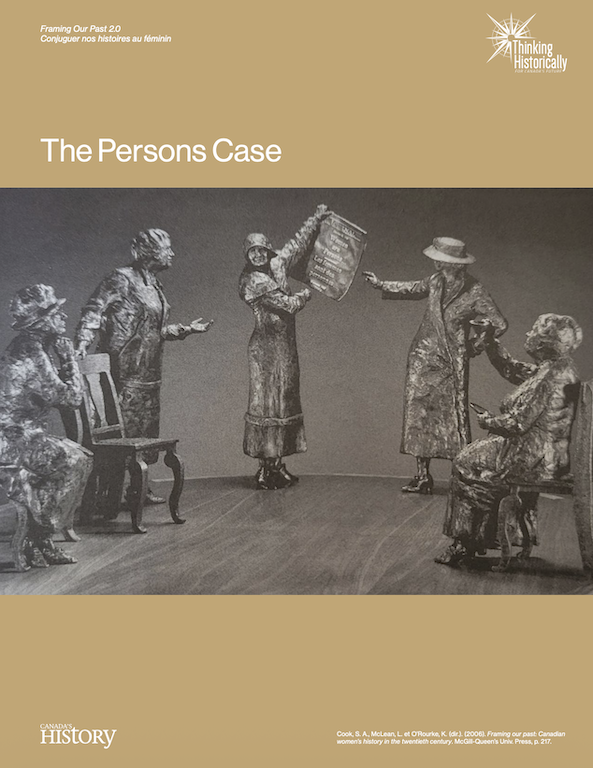
In 1927, a group of five women, led by Emily Murphy, Alberta’s first female judge, initiated a legal challenge against the narrow interpretation of the Constitution that did not consider women to be “persons.” The government would not appoint women to the Senate, arguing the British North America Act (now known as the Constitution Act, 1867) did not include women as “qualified persons,” as the act used the word “persons” in the plural sense, using the word “he."
This legal battle, now an important part of the history of women in Canada, and legal interpretations of the Canadian constitution, is known as the Persons Case. The Judicial Committee of the British Privy Council’s decision to recognize women as persons led some women to be appointed to the Senate and other public bodies. Despite the success of the “Famous Five’s” demands, many were excluded from the benefits brought by the Privy Council’s decision. It did, however, allow women greater participation in political life and was an important part of the struggle for gender equality in Canada. It was also notable for opening doors to constitution interpretation. The celebration of the women involved in the Persons Case as feminist pioneers, has recently been contested because of their involvement in eugenics movements. By studying the various historical aspects of the Persons Case and its repercussions, students will utilize their critical thinking skills and broaden their knowledge of women’s history in Canada.
⇨ What role does the Persons Case play in the history of women in Canada? What image of “women” does it evoke?
⇨ What are the results of excluding certain women from the benefits of the Persons Case, and what controversies surround the legacy of the “Famous Five” (also known as the “Famous 5”)?
Historical Significance | In this lesson, students will identify the historical significance of feminist movements from the early 20th century to the present day. Students will evaluate whether women’s lives are better today thanks to the activism of feminists such as the Famous Five. They will analyze whether the resolution of the Persons Case paved the way for all women in politics. Students will consider the historical importance given to “exceptional” historical figures. |
Primary Sources: Evidence | Students will evaluate biases and omissions in primary sources, such as newspaper excerpts from this historical period. They will learn to evaluate which voices are included and which are omitted, and which opinions are brought forward in public discussions about the role of women in politics. |
Continuity and Change | This lesson focuses on the legal change in the status of women under the Constitution Act, 1867. That said, the Famous 5 do not represent the voice of all women in Canada. In this lesson, students will learn which voices were omitted (Indigenous women, immigrant women, etc.) and they will examine the changes that have occurred in the participation of different groups of women in politics over time. |
Cause and Consequence | Students will critically evaluate the reasons why the Famous 5 challenged the legal system, in court, to have women’s status as “persons” recognized, as well as both the consequences of this battle and the final verdict. |
Historical Perspectives | The omission of the broader historical perspectives of several women’s groups meant that society’s understanding of the Persons Case in particular, but also of the rights and legal status of several women’s groups, is distinctly limited. By highlighting the historical perspective of these women’s groups, students will be able to better understand ongoing struggles and societal issues. |
Advertisement
We acknowledge the generous support of Canada’s History, Ontario Women’s History Network, Thinking Historically — For Canada’s Future Research Project, University of Ottawa Faculty of Education and SSHRC — CRSH. We also want to thank McGill-Queen’s University Press for granting the rights to use content from the Framing Our Past (2001) original book.