Your history. Your inbox.
7 uniquely curated newsletters to choose from.


This lesson is part of the Investigating the Histories of Women / Conjuguer nos histoires au féminin collection and is suitable for grade 10 to 12.
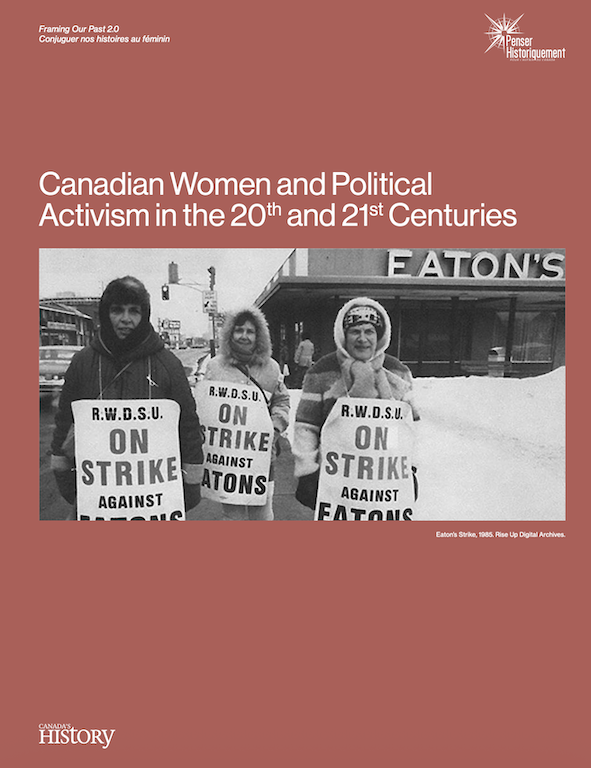
Despite facing numerous barriers to political participation, Canadian women have been involved in a variety of forms of political activism including grassroots organizing, protesting, and striking.
In this lesson, students will examine how women in the 20th and early 21st centuries played an integral part in advocating for societal change. From anti-war advocacy and consumer and worker rights to equity demands and Indigenous and Black activism, a close examination of primary and secondary sources offers students the opportunity to identify the historical context of women’s struggles and evaluate the strategies used by different women’s political organizations.
⇨ In what ways were women active in political movements and advocacy groups during the 20th century, and first decades of the 21st century?
⇨ How did different kinds of strategies implemented by women-led activist groups help shape different outcomes?
Historical Significance | The lesson highlights contributions women have made in resisting and transforming social and economic policies in Canada. The lesson touches upon significant issues of the 20th century (1920s-1960s) and early 21st century that are still relevant today including domestic labour, consumer rights, basic income, and health/healthcare. |
Primary Sources: Evidence | Students will examine several primary source documents (visual, written, and oral) in relation to women’s activist groups. |
Continuity and Change | Through a detailed exploration of women’s advocacy work, in areas such as consumer rights, labor rights, and anti-war advocacy both in the 20th and 21st centuries, students will become familiar with, and be able to identify actions such as continuity and change in social and political issues that faced society, and the grassroots movements led by women, which sought to address them. |
Cause and Consequence | The lesson highlights how women were able to advocate and influence human rights legislation despite existing legal, social, economic, and political limitations. |
Historical Perspectives | In a class, group, and individual setting, students will discuss the historical significance of the primary sources to Canadian history in order to consider several different historical perspectives. |
Advertisement
We acknowledge the generous support of Canada’s History, Ontario Women’s History Network, Thinking Historically — For Canada’s Future Research Project, University of Ottawa Faculty of Education and SSHRC — CRSH. We also want to thank McGill-Queen’s University Press for granting the rights to use content from the Framing Our Past (2001) original book.