
Victoria A.
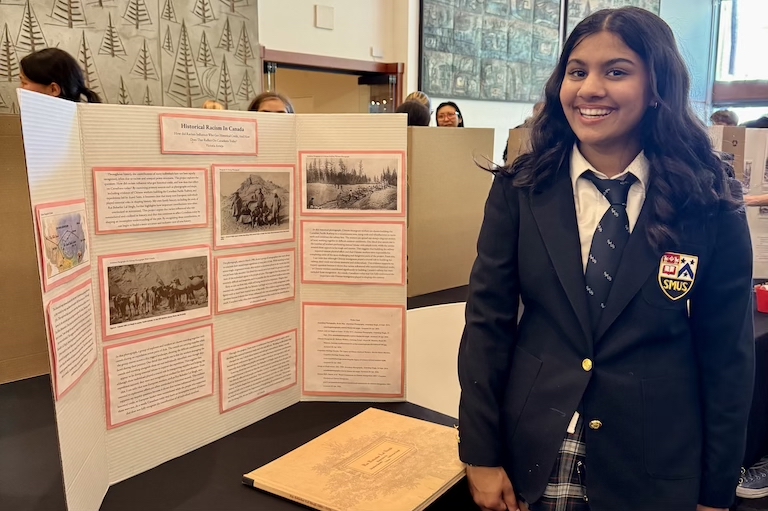
Historical Racism in Canada
Victoria A.
South Island Pop Up Fairs
Victoria, BC
My project examines how racism influenced who received historical credit and how this continues to shape Canadians' understanding of the past. My inquiry question was: How did racism influence who got historical credit, and how does that reflect on Canadians today? To answer this question, I studied two powerful examples: Chinese immigrant workers who helped build the Canadian Pacific Railway and my ancestor, Rai Bahadur Lal Singh, who played a key role in major mapping expeditions across Asia led by Sir Aurel Stein.
In the 1880s, thousands of Chinese workers were hired to complete some of the most dangerous sections of the railway through the Rocky Mountains. They worked in extremely difficult conditions, were paid less than other workers, and many lost their lives. Despite their essential role in connecting Canada, they were rarely recognized in history. In the early 1900s, Rai Bahadur Lal Singh used his skills as a surveyor and explorer to help map important parts of the Silk Road. Although his knowledge and leadership were crucial to the success of these expeditions, most of the credit was given to Aurel Stein.
My final response to my inquiry question is that racism had a major influence on who was remembered and celebrated in history. Many racialised individuals made extraordinary contributions, but their stories were often ignored. This has left Canadians with an incomplete understanding of the past. By recognizing these overlooked contributions, we can create a more accurate, inclusive, and truthful understanding of Canadian History.
What sources and evidence did you consult for your project? What different perspectives did they provide on your topic?
I explored several articles, photographs, and documents on both paper and online. They all reinforced the idea that racism did, in fact, shape who received historical credit. An article about Rai Bahadur Lal Singh by Amardeep Photography was one of the most helpful sources because it showcased the hard work done by Rai Bahadur Lal Singh and other racialized workers. This was my photographic proof of the hard work put into the expeditions.
This summer, I was traveling in Europe with my family and visited the British Library in London, England, and the Library of the Hungarian Academy of Sciences in Budapest, Hungary. They hold many original maps, documents, and archival photos that, when looking back, helped me to answer my question. Together, these sources helped me to understand the truth about how these historically significant events actually happened.
What is the historical significance of your topic?
This form of racism affects countless people, but I narrowed my project down to two stories. Chinese immigrants who were forced to build the Canadian Pacific Railway, and my great-great-grandfather, Rai Bahadur Lal Singh, who explored and mapped parts of Asia. Both of these examples affected the recipients' lives and those of generations to come. I want to discuss the historical significance of this topic so we don't repeat past mistakes. It is natural for humans to want to achieve greatness, so when we see others succeed, we sometimes wish that success were ours. As a result, people may try to justify why they deserve credit and claim achievements they did not earn to feel better about themselves. As a society, we have come so far, but at the same time, we haven't. We see this pattern repeated when we think about residential schools or the Chinese Exclusion Act. We need to keep talking about the less glamorous parts of Canadian history until the message sticks.
Why did you choose this topic?
When people think of racism, they normally think of the terrible kind of overt discrimination that is visible and extreme, and yes, this is definitely something that happened very frequently. However, there are different forms of racism, many of which aren't visible or direct. I wanted to explore a kind of racism that isn't recognised normally, one that is just as hurtful but doesn't give you a visible scar. Another reason why I chose to research this topic was because my great-great-grandfather experienced this kind of racism for his life's work. My great-great-grandfather, Rai Bahadur Lal Singh, spent the majority of his life on expeditions to map and explore parts of Asia with a small racialised group. After all their hard work and manual labour, the only noticeable white man took credit, calling Rai Bahadur Lal Singh and the others his assistants. This story really speaks to me because nobody really knew what happened on those several expeditions, and this man died thinking nobody would ever recognise his life achievements. This form of racism is one that not only affects the recipient, but it also affects generations to come, and as a direct descendant of the recipient, I can confirm that. Throughout my research, I've noticed that these stories are so often overlooked, so I wanted to shed light on one of the many people that this has affected. I chose a racism based topic because I believe that it is a subject worth talking about and fully understanding before we make judgments.