
Sviatoslav B.
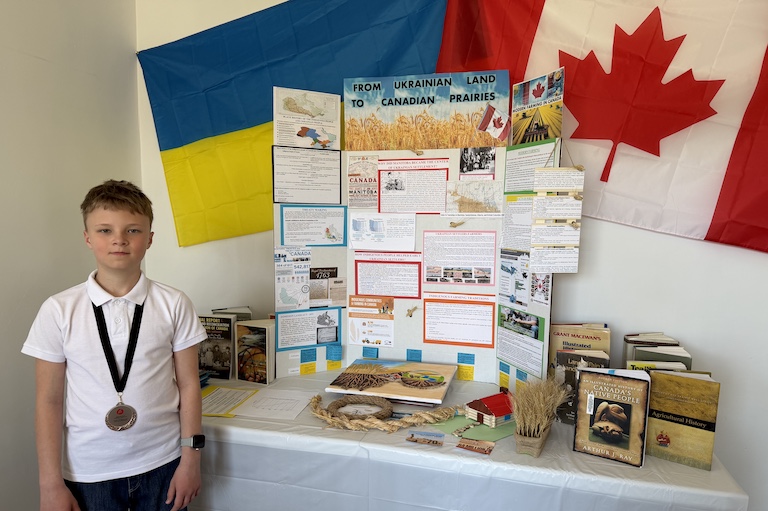
From Ukrainian Land to Canadian Prairies
Sviatoslav B.
Red River Heritage Fair
Winnipeg, MB
My Heritage Fair project focuses on Indigenous and Ukrainian relationships to the land, the immigration process of Ukrainians, and the development of farming in Canada.
I began my inquiry with the question, “Why did Ukrainians begin immigrating to Canada in 1891?” I also wondered how this immigration impacted agriculture in Canada. To find answers, I needed to understand the history of Indigenous Peoples, the loss of their lands and rights, and how they helped Ukrainian immigrants settle.
I conducted a comparative analysis of land legislation in Canada and Ukraine from the 1880s to the present, identifying similarities such as loss of land control, forced relocations, and restrictions on land-use rights.
I was curious about how the history of Ukrainian immigrants is connected to the history of Indigenous Peoples. Government policies, such as the Dominion Lands Act and the Treaties, had a significant impact. The Dominion Lands Act and Clifford Sifton’s advertising campaign, “The Last Best West,” encouraged immigration. This made settlement of the land possible, but it also had serious consequences for Indigenous Peoples. Studying this history helps me understand the importance of Reconciliation today.
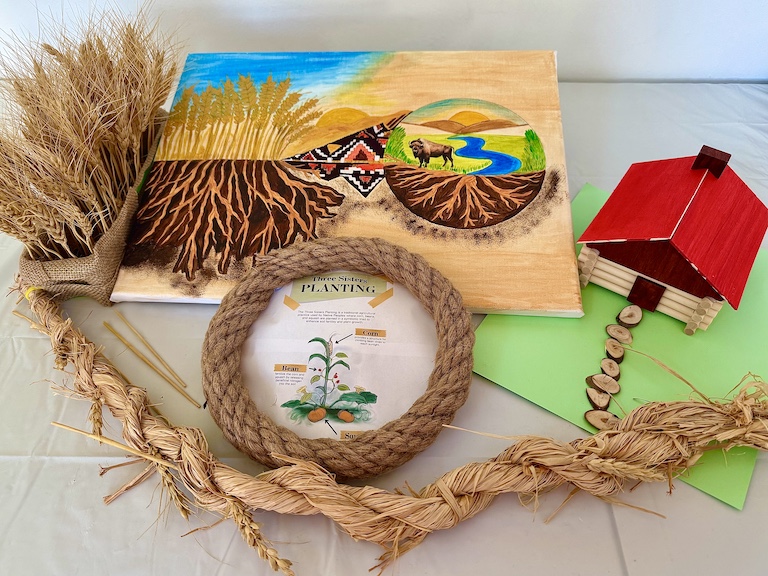
Ukrainian immigrants came to Canada with the promise of land to farm, but they faced numerous challenges because of the harsh climate. Meanwhile, Indigenous Peoples shared practical knowledge about the land, seasons, climate, plants, and survival on the prairies. Research indicates that they made a significant contribution to the newcomers’ survival. For Indigenous Peoples, land is more than property – it is a Mother Land that represents culture, spirituality, and identity.
My project illustrates the connection between the stories of Ukrainian and Indigenous Peoples, highlighting the role of Indigenous Peoples in helping newcomers adapt. It promotes a better understanding of colonization and encourages respect and reconciliation in Canada.
What sources and evidence did you consult for your project? What different perspectives did they provide on your topic?
For my project, I used a wide range of historical, academic, and government sources to understand how Ukrainian settlers and Indigenous Peoples contributed to the development of agriculture in Manitoba, as well as to explore Indigenous and Ukrainian relationships to land, the immigration process, and the development of farming in Canada. These sources included books, academic studies, government reports, historical maps, statistical data, interviews, archival materials, encyclopedias, websites, and articles.
First, I used academic books about Ukrainian immigration and settlement, such as Trailblazers of Ukrainian Emigration to Canada: Wasyl Eleniak and Ivan Pylypow (Nay, 1976), Community and Frontier (Lehr, 2011), Ukrainians in Canada: The Formative Period, 1891–1924 (Martynowych, 1991; 2005), and Land of Pain, Land of Promise: First Accounts by Ukrainian Pioneers, 1891–1914 (Piniuta, 1978). These sources provided information about Ukrainian settlers, explaining why Ukrainians emigrated, how they established farms, and how Manitoba became a centre of Ukrainian agricultural life. They showed that Ukrainian farmers brought important agricultural knowledge and helped develop grain farming in Canada.
Second, I used historical and agricultural studies, including The Canadian Prairies: A History (Friesen, 1987), Western Canadian Agriculture to 1990 (Horner, 1990), and Agricultural History (Marchildon, 2012), which explain how agriculture expanded over time and became a key part of Canada’s economy.
To better understand Indigenous perspectives, I used works such as Lost Harvests (Carter, 1990), Clearing the Plains (Daschuk, 2013), and The Canadian Prairies: A History (Friesen, 1987). These sources explained that Indigenous Peoples had long-standing systems of land use and environmental knowledge. They provided Indigenous perspectives, showing that agriculture and sustainable land management existed long before European settlement and that government policies significantly affected Indigenous farming communities.
I also reviewed sources on Treaties, the Royal Proclamation of 1763, the Dominion Lands Act, and land policies, including Jim Aldridge’s Keeping Promises (2015), An Illustrated History of Canada’s Native People (Ray, 2016), First Nations in Canada (Pointing, 1997), and Honouring the Truth, Reconciling for the Future: Summary of the Final Report of the Truth and Reconciliation Commission of Canada (2015).
In addition, I referred to local histories and biographies by authors such as Michael Ewanchuk and Victor Kaye that described the lives of Ukrainian pioneers. These sources showed the daily challenges settlers faced and how they adapted to life on the prairies.
To support my research with data, I examined statistical information from Statistics Canada. Based on this data, I created my own diagram showing the growth of wheat production from the 1890s to the present. This helped me visually demonstrate how agriculture expanded over time and became an important part of Canada’s economy.
To connect my topic to the present, I also conducted interviews with two Canadian farmers, Greg Woytowich and Glenn Cymbalisty, who both have Ukrainian roots and whose families have been farming in Canada for four generations. Also, Glenn’s grandmother, Nellie Cymbalisty, immigrated to Canada in 1907 with her family, including her brother Stefan Obelnicki, who was Glenn’s great-uncle. Later, Stefan played an important role in establishing The Ukrainian Farmers’ Cooperative in Fisher Branch, Manitoba, where he was elected president. These interviews provided a modern and generational perspective, showing how farming traditions and values have been passed down over time and remain important today.
Additionally, I visited a library archive department, where I explored historical documents about the first Ukrainian immigrants. These records helped me understand why Ukrainians came to Canada, showing that many were motivated by poverty, land scarcity, and the opportunity for a better life.
Finally, I used maps and visual materials to understand where people lived and how the land was used. I examined maps of Ukrainian settlements and treaty maps showing Indigenous lands. This helped me understand that Ukrainian settlers built communities on lands that were already home to Indigenous Peoples, and that it is important to recognize and respect this history.
What is the historical significance of your topic?
The historical significance of my topic lies in its exploration of how agriculture in Manitoba evolved with the arrival of Ukrainian settlers and the enduring presence of Indigenous Peoples. It illustrates how migration, government land policies, and knowledge of the land collectively shaped one of Canada’s most important industries.
In the short term, Ukrainian settlers helped expand farming by clearing land and growing crops such as wheat, which increased food production and contributed to the growth of rural communities. At the same time, these changes affected Indigenous Peoples, as land use shifted and traditional ways of life were impacted.
In the long term, Manitoba became a major agricultural region, and Canada became one of the world’s leading wheat producers. Ukrainian farming traditions influenced this development, while Indigenous knowledge of the land remains important today, especially in discussions about sustainability and environmental stewardship.
This process affected many groups. Ukrainian settlers gained land and new opportunities, while Indigenous communities experienced major changes connected to land use and government policies. Over time, the prairie landscape was transformed, agriculture became more modernized, and there is now greater recognition of Indigenous history, treaty relationships, and the importance of Reconciliation.
This topic is important because it demonstrates that the development of agriculture in Canada was shaped by different peoples and perspectives. Understanding this history helps us better comprehend both the past and the present.
Why did you choose this topic?
I chose this topic because it holds personal significance for me. As an immigrant from Ukraine living in Canada for the past three years, I became interested in how earlier Ukrainian immigrants adapted and built their lives here.
Another key reason for my interest is my family background. My grandfather is a third-generation farmer in Ukraine, managing a family farm where he grows wheat and raises cattle. I've witnessed how hard and demanding this work can be, which has instilled in me a deep respect for farmers. I wanted to learn more about how Ukrainian farmers have contributed to agriculture in Canada.
Additionally, I wanted to explore the history of Indigenous Peoples in greater depth and understand how immigration processes affected their lives. This approach allowed me to view the topic from multiple perspectives and appreciate the complexity of Canadian history.