
Sanaa M. and Mumtaz W.
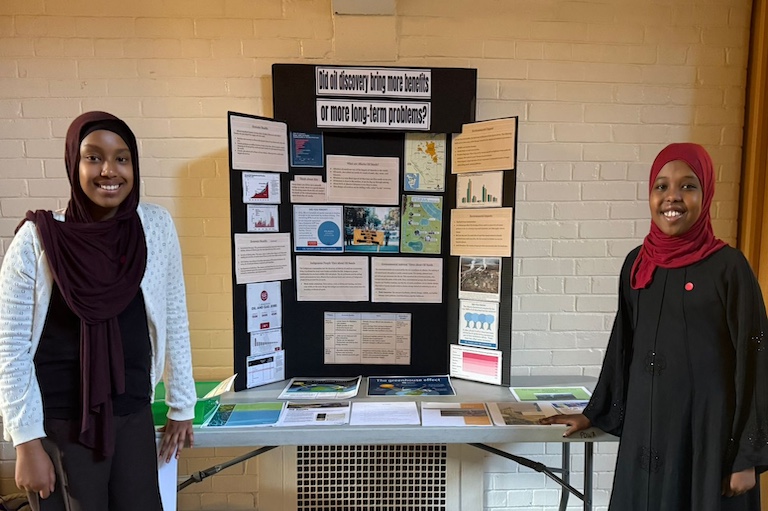
Alberta Oil Sands
Sanaa M. and Mumtaz W.
Edmonton Regional Fair
Edmonton, AB
Alberta’s oil sands are one of the largest oil sources in the world. Oil sands are made of sand, water, clay, and bitumen, which is a thick type of oil. Some bitumen is close enough to the surface to be mined, while most of it is deep underground and removed by drilling methods called in situ recovery.
The discovery of oil sands greatly changed Alberta and Canada. Alberta became the center of Canada’s oil industry, supplying most of the country’s oil. The oil industry helped Canada become one of the world’s largest oil exporters. Cities like Calgary and Edmonton grew quickly because of the oil economy. Thousands of jobs were created, workers earned higher salaries, and governments made billions of dollars from oil revenue. This money helped build roads, transportation systems, and other infrastructure.
The main groups involved in Alberta’s oil sands were the Canadian government, Alberta leaders, oil companies, and oil workers, who supported oil because it created jobs and made money for the economy. Environmental groups like Greenpeace Canada and Pembina Institute worried about pollution and damage to nature. Indigenous communities and local people are concerned because the polluted land and water has affected their traditional way of life such as hunting, fishing, gathering and traditional ceremonies.
Different groups have different opinions about the oil sands. The government and oil workers mostly see oil as a success because it created jobs and revenue. Environmental groups and many Indigenous communities are more concerned about pollution and damage to the land.
In conclusion, Alberta’s oil sands helped Canada’s economy grow, but they also caused serious environmental and social problems. If we look at the long-term effects of mining and drilling, it is very clear that they have damaged forests, rivers, and wildlife habitats. Pollution and greenhouse gases contributed to climate change. Majority of these long-term effects are not reversible which will affect the future generations.
What sources and evidence did you consult for your project? What different perspectives did they provide on your topic?
We used numerous websites and publications, and interviewed an oil industry worker for our project.
Indigenous Perspective:
From the articles and websites, we found information on the perspective of the Indigenous communities and the environmental effects on their daily lives. The Indigenous communities saw the discovery of Alberta oil sands as a concerning thing. It polluted the local water bodies and killed the fish. Indigenous people traditionally live on local wildlife, fish and plants. The air pollutants and the tailing pond contaminations have affected the traditional lands and customs of Indigenous people living around the oil sands, especially the Fort McKay First Nations and the Métis community near the Athabasca oil sands. The main concerns are about the effect on their cultural practices due to loss of sacred lands, water contamination, and deforestation. The ecosystems are affected by the oil sands, which as a result is creating difficulty in medicine gathering and hunting for their survival.
Environmentalists’ Perspective:
Environmentalists are concerned about the rise in pollution in Alberta. The mining of oil caused much disruption to earth’s natural cycles. The mining released more greenhouse gas emissions into the air. This concerned the environmentalists, who worried about the safety of the earth. Many environmental groups, like Greenpeace Canada and Pembina Institute, say that the oil sands contribute a lot to climate change. They believe Canada should switch to cleaner energy instead of continuing to rely on polluting fuels. Their main concerns are the amount of pollution, climate change, wildlife, and habitat damage, water pollution, land disturbance, pipeline battles etc.
Government Perspective:
The government saw the oil discovery as a major economic success and they made billions of dollars yearly from Alberta oil. The oil discovery is viewed as one of the most important events in Alberta’s history. They had a very positive perspective on the oil discovery because of the many benefits:
- Government Revenue: The government lowered tax rates due to the oil sands making citizens of Alberta pay less taxes than the rest of the country.
- Growth of Alberta cities: The major cities in Alberta like Calgary and Edmonton rapidly grew and the oil sands caused them to evolve into major energy centers.
- Job Creation: According to Canadian Association of Petroleum Producers, in 2023, the oil and gas industry employed 150k Canadians.
- Development of industries: The revenue and funds from the oil and gas industry helps government spend the money on the development of industries like transport, construction, and infrastructure.
What is the historical significance of your topic?
Significance:
- Oil was discovered in Leduc in February 1947. This changed Alberta’s economy from farming to the oil and gas industry.
- Before the oil boom, Saskatchewan had more people than Alberta. After oil was discovered in Leduc, many workers moved to Alberta, and the populations of Edmonton and Calgary quickly increased.
- The oil industry has helped Alberta become wealthy. It has given the province a strong economy, low taxes, and many job opportunities for people.
Who is affected?
- Local Indigenous communities
- Global effects & climate change
- Wildlife habitat loss
Economic Benefits:
- Alberta benefited Canada a lot due to the oil sands. Alberta not only helped Canada, but also helped to supply oil to the world.
- Business and economy in Alberta skyrocketed when oil was discovered in the soils of it.
- Canada produces 4.9 million barrels of crude oil per day. Alberta quickly started shipping oil all around the world and made Canada the 4th largest oil exporter in the world.
- Canada gets about 90% of their oil from Alberta. Alberta has the world's third largest oil reserves.
- Government Revenue: The government lowered tax rates due to the oil sands making citizens of Alberta pay less taxes than the rest of the country.
- Growth of Alberta cities: The major cities in Alberta like Calgary and Edmonton rapidly grew and the oil sands caused them to evolve into major energy centers.
- Job Creation: According to the Canadian Association of Petroleum Producers, in 2023, the oil and gas industry employed 150k Canadians.
- Development of industries: The revenue and funds from the oil and gas industry helps government spend the money on the development of industries like transport, construction, and infrastructure.
Environmental Effects
- Just as it has its benefits, the discovery of Albertan oil also has its downs. The following bullet points show some of the damage caused by the mining and extraction processes.
- Wildlife and Habitat Damage: Large areas of forests have to be cut down or destroyed so mining can be done, therefore leading to the loss and damage of animals' homes.
- Health Risks to local communities: The emission of gases due to oil extraction raises health risks and medical concerns toward local communities.
- Predator Highways: Pipes dug out by mining and left on highways create paths for predators, like wolves to enter human populated areas.
- Water Impacts: Large amounts of toxic wastewater is released in bodies of water called tailing ponds, causing pollution. Effects on fish etc…
- Greenhouse gas effect: The burning of these sands to extract the oil causes pollution in the air, releasing evaporated chemicals, and affecting climate change.
- Rail cars that carry tar sands (the oil sands that Canada mines) in densely populated areas could cause fires, like the incident on October 19, 2013 in Gainford Alberta.
- Land Disruption/Deforestation: The creation of open pit mines permanently alter the landscape.
Why did you choose this topic?
We chose this topic because of the many different perspectives it contained. The more perspectives we explored and researched, the more information we were able to collect. Another reason we selected this topic is because of its historical significance to Alberta. The discovery of oil has a major impact on the province’s economy, development, and a global level contribution. All of this made it a very interesting topic to research. The last reason was that, one of our group member’s father works in the oil industry, and we were able to interview him for our research as well.