
Samara J. and Sofia J.
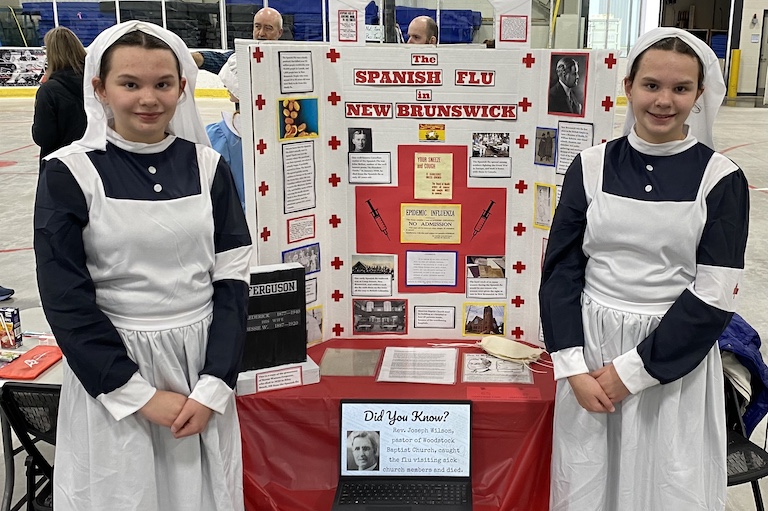
The Spanish Flu in New Brunswick
Samara J. and Sofia J.
Anglophone West School Distract Regional Heritage Fair
Fredericton, NB
What was the Spanish Flu and how did it affect New Brunswick? The Spanish Flu was a deadly pandemic that killed over 50 million people worldwide, and 1,400 people in New Brunswick. People who were 20-40 years old were most likely to die from this flu. Some symptoms were high fevers, headaches, chills, fatigue, muscle aches, pneumonia, purplish-black skin, and bleeding from the mouth and nose. People often died within 12-20 hours. There was no cure at the time.
The Spanish Flu probably started in China in 1918, but was first reported in Spain and spread quickly among soldiers in Europe at the end of the Great War. Many Canadian soldiers carried the deadly disease back home. A force of Canadian troops gathering at Camp Sussex, New Brunswick, took the flu with them on the train all the way to British Columbia, spreading it as they went. New Brunswick saw more than 35,000 Spanish Flu cases, starting in October 1918.
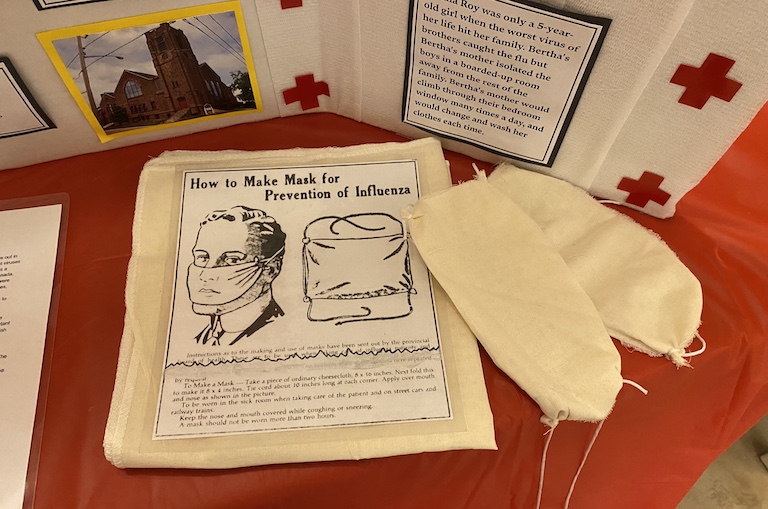
Many patients wouldn't have lived without nurses, who provided the only effective treatment available at the time, supportive care. New Brunswick had appointed the British Empire’s first Minister of Health, Dr. William Roberts. He started just before the pandemic, and closed schools, theatres, churches, gatherings, and meetings. His rules and the work of the Department of Health and the nurses helped New Brunswick have the second-lowest death rate among Canadian provinces.
We learned about one girl who survived the Spanish Flu, Ella Isobel Rogers, from Hopewell Hill, New Brunswick, who described catching the flu in her diary. We also learned about Bertha Roy, a 5-year-old girl in Balmoral, New Brunswick, whose mother isolated her sick brothers in a boarded-up room away from the rest of the family, climbing through their window many times a day whenever they needed something.
What sources and evidence did you consult for your project? What different perspectives did they provide on your topic?
We learned a lot and found many interesting pictures in the New Brunswick Archives “Spanish Flu Exhibit” (https://archives.gnb.ca/Exhibits/SpanishFlu/en/).
We found a diary written by Ella Isobel Rogers talking about having the flu (https://wardiaries.ca/s/operationcanada/page/ella-rogers-1918-1921#).
We read and watched a news story about Bertha Roy, who lived through both COVID-19 and the Spanish Flu (https://globalnews.ca/news/6828112/n-b-106-year-old-grandmother-two-pandemics/).
These sources are from people who lived through the Spanish Flu themselves and saw it firsthand.
We also read several online news stories about how the Spanish Flu affected our province. A medical website told us lots about the Spanish Flu itself (https://my.clevelandclinic.org/health/diseases/21777-spanish-flu). These sources are from people who addressed the topic later and provided more detailed information about it.
What is the historical significance of your topic?
Long term, the Spanish Flu still exists today but has evolved into a less deadly H1N1 virus over time. The Spanish Flu helped shape health care today and how we deal with pandemics today. While Dr. Roberts was the first minister of health in the British Empire, after the Spanish Flu, other governments appointed ministers of health as well. Short term, the hard work of so many women during the Spanish Flu and their risking their lives for others helped women to win the right to vote in New Brunswick in 1919.
Why did you choose this topic?
We chose this topic because I (Samara) want to be a nurse when I grow up, and I (Sofia) wanted to know how the Spanish flu has affected our province and country, We’re so thankful for things like vaccines and health care that we enjoy partly because of what they went through during the Spanish Flu. We’re also thankful for all the women who helped during the Spanish Flu and helped women win the right to vote.