
Raina L.
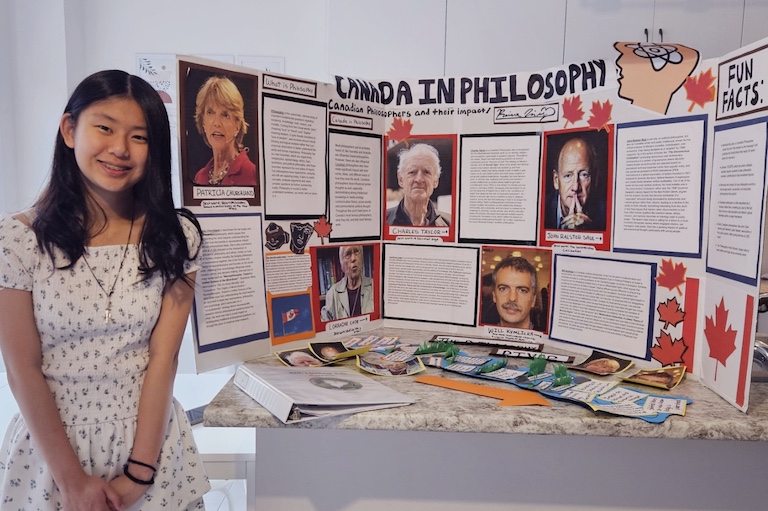
Canada in Philosophy
Raina L.
Simcoe County Heritage Fair
Midhurst, ON
Philosophy. Philosophers. Many people when they hear those two words automatically think of great Greek philosophers such as Plato or Socrates. What many don’t know don’t know is that Canada has its own amazing philosophers with so many unique ideas and works!
First of all, what is philosophy? Philosophy is the systematic, rational study of important fundamental questions regarding existence, knowledge, truth, reason and morality. Coming from the Greek words “Philo” (meaning “love” or “friend”) and “Sophia” (“wisdom”), it quite literally translates to “love of wisdom” and revolves around critical thinking and logical analysis rather than just empirical observation to better understand the world and human experiences! And Canadian philosophers have sparked many discussions and added into the world of philosophy with their ideas and works!
It’s not just thoughts within Canada that these philosophers have influenced, they've also affected global thoughts as well. Especially, demonstrating strong intellectual knowledge in philosophical roots such as media ecology communication theory and social identity just to name a few. Did you know that one of our very own philosophers coined Neurophilosophy as a field and is the founder of it? That one of our very own philosophers changed how governments manage diversity? And even shifted views on how knowledge is understood? My project centers itself around five major Canadian philosophers, Patricia Churchland, Lorraine Code, Charles Taylor, Will Kymlicka and John Ralston Saul respectively, what they did, and how their ideas and works impacted Canada!
After my research and project was done, I learned that these Canadian philosophers have heavily impacted Canada by opening up various new viewpoints on things like social policy, and by giving Canada a unique, community-oriented identity. They’ve also helped Canada define values, including respecting minority rights, and a commitment to public institutions like universal healthcare!
What sources and evidence did you consult for your project? What different perspectives did they provide on your topic?
Most of the philosophers who were featured on my project actually have their own official websites, so I got a lot of my information for each philosopher from their dedicated websites! My second biggest resource I used is the Canadian Encyclopedia, since they have a lot to say about Canada in philosophy and Canadian philosophers. I also used university profiles from the universities that the philosophers used to work at, and digital book listing to find their works. I got to learn about the philosophers in many different ways, whether it was biographies or what each of their works were about!
What is the historical significance of your topic?
The Canadian philosophers that I researched about in my project left a lot of impacts that stayed with Canada after they released their works, like huge impacts on political and economic thoughts, and revitalizing studies on Secularism. Again, Canada was affected by these ideas in many different ways that is still crucial today!
Why did you choose this topic?
Philosophy is my favorite subject, and it’s what sparked my learning for various other academic fields that school doesn’t teach for me just yet. To me, philosophy is probably the best thing and the one subject I have the most fun learning about. I wanted my Heritage Fair Project to be something that was special and fun to me, rather me just doing it because my teacher told me to. And since most people just know about major Greek philosophers like Socrates, I thought it’d be cool to teach others that we have very important and impactful philosophers right here in Canada!