Miraaj M. and Rimsha R.
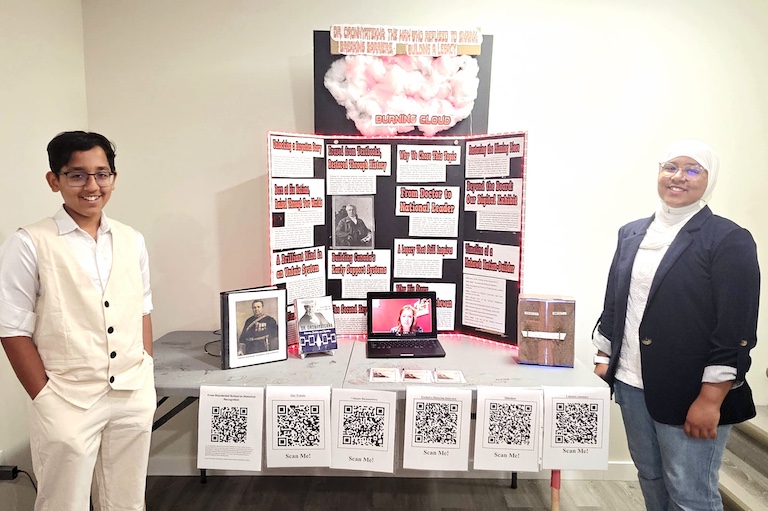
Dr. Oronhyatekha: The Man Who Refused to Shrink, Breaking Barriers, Building a Legacy
Miraaj M. and Rimsha R.
Saskatoon Heritage Fair
Saskatoon, SK
Dr. Oronhyatekha was born in 1841 at Six Nations of the Grand River and belonged to the Mohawk Nation and Turtle Clan. As a child, he attended the Mohawk Institute during a time when Indigenous students faced strong pressure to grasp into colonial society. Although he was originally trained in shoemaking, he pushed beyond those expectations and continued pursuing higher education. His determination to move beyond the role assigned to him became one of the inspiring parts of his story.
In 1860, he impressed the Prince of Wales during a public ceremony, which helped open new educational opportunities for him. He later studied at Oxford University and earned a medical degree in Toronto, becoming one of the earliest Indigenous physicians in Canada. However, his influence extended far beyond medicine. As leader of the Independent Order of Foresters, he transformed the organization into an internationally respected institution that supported widows, children, and families. Under his leadership, the organization expanded across multiple countries and became known for its strong community support systems. His achievements challenged barriers during a period when Indigenous people were often excluded from positions of influence and leadership in Canadian society.
One of the most meaningful parts of our project was interviewing Michelle Hamilton, co-author of the biography Dr. Oronhyatekha: Security, Justice, and Equality. Speaking with someone directly connected to the research behind his life story gave us a deeper understanding of both his achievements and why his story deserves greater recognition today.
Our final response to our inquiry question was that Dr. Oronhyatekha’s identity and impact cannot be separated. His Haudenosaunee values shaped the way he led, supported communities, and created lasting change across Canada.
What sources and evidence did you consult for your project? What different perspectives did they provide on your topic?
We used a wide variety of sources, including books, academic articles, museum resources, archival photographs, documentaries, interviews, and historical websites. Some of our most important sources included The Canadian Encyclopedia, Parks Canada, the Dictionary of Canadian Biography, the Royal Ontario Museum, the Woodland Cultural Centre, and the biography Dr. Oronhyatekha: Security, Justice, and Equality by Keith Jamieson and Michelle Hamilton.
A major part of our research was interviewing Michelle Hamilton, co-author of the biography. This gave us a more personal and detailed perspective on Dr. Oronhyatekha’s life, leadership, and historical significance. Different sources also helped us understand multiple perspectives on his story, including his achievements as a physician and institutional leader, his Mohawk identity, and the challenges Indigenous people faced during the colonial period.
What is the historical significance of your topic?
Dr. Oronhyatekha’s leadership had both immediate and long-term impacts. During his lifetime, he transformed the Independent Order of Foresters into a major international organization that supported families, widows, and children during difficult times. His leadership challenged social barriers during a period when Indigenous people were often excluded from positions of influence.
In the long term, his story continues to influence discussions about Indigenous leadership, representation, and overlooked Canadian history. His life reminds Canadians that Indigenous leaders played major roles in shaping institutions and communities across the country. Today, his legacy is remembered through museums, books, educational initiatives, and historical recognition projects.
Why did you choose this topic?
We chose Dr. Oronhyatekha because his story is important but often overlooked. We were inspired by how he stayed true to his identity while achieving extraordinary success during a difficult time in Canadian history. His story connected perfectly to our project theme of identity and impact.