
Marco H. and Declan F.
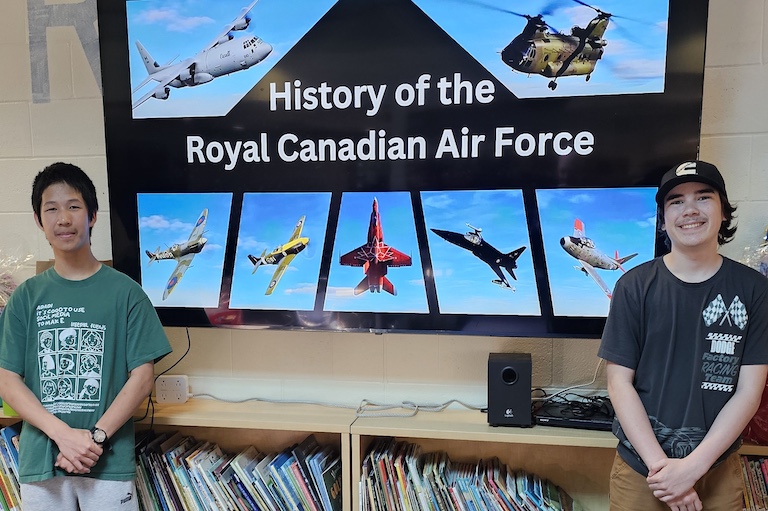
The History of the Royal Canadian Air Force
Marco H. and Declan F.
Kingston Regional Heritage Fair
Kingston, ON
In April of 1924, the Canadian Air Force was renamed to the Royal Canadian Air Force, marking the change to a permanent military branch. After the start of the Second World War, Prime Minister William Lyon Mackenzie King signed the British Commonwealth Air Training Plan, which caused a rapid expansion of the RCAF. During the Battle of the Atlantic, RCAF pilots accounted for more than 200 U-Boat kills, and during the Battle of Britain, over 100 Canadians served, 23 of which lost their lives. In the Dambusters Raid, a bombing operation no one would forget and one that would not have happened without Canada, the bomb was dropped low to create backspin so it would skip across the water. The plan was deemed irrational; it took a Canadian man, Max Aitken, to convince the government to let the plan go through. Most bombing runs weren't done remotely similar to the Dambusters Raid, as most bombing was done under the cover of night.
In the invasion of Normandy, 39 of all 42 squadrons were sent, most of which were fighter and paratrooper squadrons. Many pilots never returned home, but the ones that did received many awards for their efforts. The RCAF accounted for over 123 confirmed kills and many more damaged.
As the Cold War rolled around, the RCAF put millions into new aircraft and aerospace engineering. The collapse of the USSR had brought peace, but it didn't take long for that peace to be disrupted. As many wars broke out, Canada served for many of them, sending units to Afghanistan, Iraq, Jordan, Lebanon, Kuwait, and more by serving NATO and assisting the United States.
In short, the RCAF continues to develop. As we develop and grow, the RCAF will continue to serve Canada and the world when it needs it.
What sources and evidence did you consult for your project? What different perspectives did they provide on your topic?
There were many sources used for this project which can be summarized. The first is the official website of the Government of Canada (https://www.canada.ca) which has pages of the air force and then historical and current aircraft of the air force. Another main source was the Canadian Encyclopedia (https://thecanadianencyclopedia.ca/); which has an article on the RCAF and articles on more specific events and historical figures (e.g. William L. M. King, Canadian Aviation Corps). Another source which was used a lot was “On Windswept Heights II” which is, as described on the page, “Historical highlights of the Royal Canadian Air Force.” Some sources are not websites that were used repeatedly such as the a CBC Radio article on the Dambusters Raid (https://www.cbc.ca/radio/sunday/the-sunday-edition-november-4-2018-1.4888960/canadian-airmen-were-key-to-the-wwii-dam-busters-1.4888985).
One of the sources which may not have provided information from decades ago but has recent experience would be LCol Jixiang Hu. He was in Operation Impact & Operation Presence and provided images, one of him in Kuwait and another of him in Mali. Along with those he showed us links to the webpages on Operation Impact & Operation Presence which were used extensively. Having a service member of the RCAF helped provide more insight towards this topic as a whole. All these sources combined allowed our project to tell its story.
What is the historical significance of your topic?
The RCAF had many impacts on how Canada and the world are today. During the Second World War, the RCAF provided much needed support to allied forces. Ensuring the Allies would maintain air superiority was needed. Over time, the RCAF eventually became the 4th largest air force in the world until the Second World war ended.
The Cold War following the Second World War led to major innovations in aviation technology. The RCAF implemented more advanced engines on the F-86 than the original American engines. As well, the Avro CF-105 Arrow was meant to go into service being the most advanced plane of its time. During the Korean War the RCAF aided in the transportation of many resources as well as lending a few pilots to aid the USAF. And since 1958, the RCAF has also contributed to Airspace defense in the North American continent under NORAD.
The RCAF contributed aircraft and manpower to NATO to help operations and continues to do so to this day. Shortly after the collapse of the USSR the Global War on Terrorism began. Technically before the War on Terrorism, the Kosovo War had RCAF involvement, running missions for the first time since Korea. After the attacks on September 11, the RCAF aided the global effort by running more missions. Operation Apollo was the Canadian operation that was run in Afghanistan which lasted 2 years. Operation Impact focused on the development of Iraq and surrounding nations.
The RCAF conducted over 1000 sorties in Iraq. Operation Presence is part of Canadian commitment to peacekeeping under the UN. For over a century, the RCAF has shaped how the world looks today and will continue to do so when needed again.
Why did you choose this topic?
We (Marco & Declan) decided on this topic as a way to submit a project about aviation. Along with that, the fact that Digital Combat Simulator World was available to help make scenes for the video and Marco’s father is a member of the RCAF made this topic one that we could bring to life within the time frame given to make the project. In short, we both love aviation and we thought this project was a great opportunity for us to showcase it.