
Manvir V.
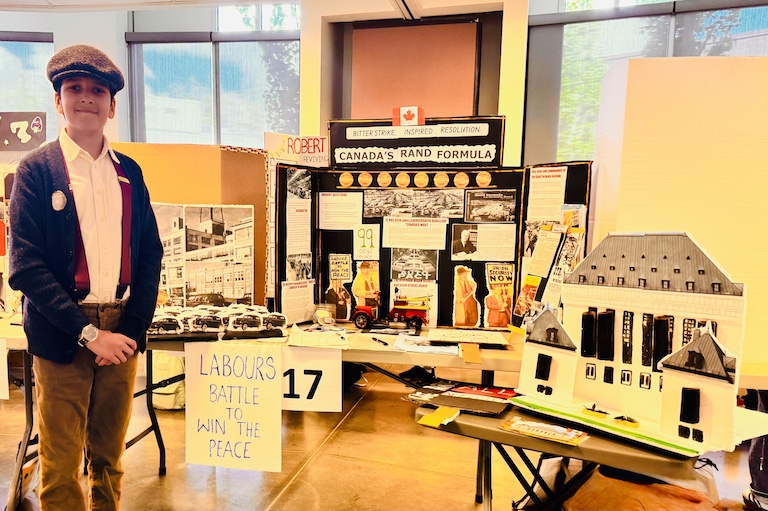
Canada's Rand Formula: Bitter Strike, Inspired Revolution
Manvir V.
Delta Heritage Fair
Delta, BC
The Canadian Rand Formula is a foundational legal principle that shaped modern labour relations in Canada. Established in Janurary 1946 by Supreme Court Justice Ivan Rand, it successfully resolved a bitter 99-day strike at the Ford automotive plant in Windsor, Ontario. The formula introduced a historic compromise to settle the fierce conflict between union demands for a mandatory closed shop and management’s firm push for an open shop environment.
Under the Rand Formula, workers in a unionized workplace have the explicit choice to join or not join the union organization. However, all employees within that specific bargaining unit must pay union dues, regardless of their official membership status. This mechanism directly eliminates the classic "free-rider" problem. It successfully ensures that everyone who benefits from union negotiations, collective agreements, and workplace representation contributes financially to support those core services.
The social and economic impact of this landmark legal ruling cannot be understated. It provided Canadian unions with long-term financial stability and institutional security, which allowed them to effectively represent workers and bargain for better conditions. Simultaneously, it protected individual worker freedom by ensuring no one is forced to formally join an organization against their will. By balancing collective strength with personal liberty, the Rand Formula brought stability and peace to volatile Canadian workplaces. It established a framework of industrial democracy that remains a key cornerstone of the country's labour laws today.
They ruled that collective bargaining stability justifies this minor financial obligation. Today, it stands as a uniquely Canadian solution, contrasting sharply with the "right-to-work" laws. Ultimately, the Rand formula did more than just settle a single dispute; it established a unique social contract that continues to govern millions of workplaces today. This enduring framework ensures that the hard-won victories of the 99-day strike are preserved through a transparent and balanced legal system.
What sources and evidence did you consult for your project? What different perspectives did they provide on your topic?
My process of research was very organized and systematic for my project. I used both primary and secondary sources. For example, I used books, ebooks, and newspaper articles. I also used CAPES (Context, Audience, Purpose, Evidence, Support) for my primary sources. It was useful to create my inquiry question and support in my research.
- C — Context: The Rand Formula was created in 1946 after a major strike at Ford Motor Company in Windsor. Canada was experiencing growing industrial unions after World War II, and there was conflict between workers and employers over union rights and wages.
- A — Audience: unionized workers, employers, labour unions, and the Canadian government.
- P — Purpose: end the labour dispute, create fairness in unionized workplaces and prevent future strikes.
- E — Evidence: workers benefiting from union negotiations even if they did not pay dues, ongoing labour unrest during the 1945–46 strike, economic pressure caused by factory shutdowns.
- S — Support / Significance: shaped Canadian labour law, reduced labour conflict, strengthened unions financially and influenced workplaces across Canada for decades.
Different perspectives were seen while I was researching primary sources and secondary sources. Many union workers argued, some employers and anti-union workers argued. This showed the tensions and opinions people had during the actual dispute. Many historians described the Rand Formula as a compromise between labour and business.
What is the historical significance of your topic?
The historical significance of the Rand Formula is that it became the foundation of modern labour relations in Canada.
Key reasons it was significant:
- It helped reduce strikes and conflict between workers and employers after World War II.
- It gave unions stable financial support by requiring all workers in a unionized workplace to pay dues.
- It balanced individual freedom (workers did not have to join the union) with collective responsibility.
- It strengthened the labour movement and improved workers’ wages, benefits, and working conditions across Canada.
- It influenced Canadian labour laws and union practices for decades and is still used today.
Short-Term Impacts:
- Ended the 1945–46 strike at Ford Motor Company.
- Reduced immediate conflict between workers and employers.
- Gave unions stable funding through mandatory union dues.
Long-Term Impacts:
- Strengthened labour unions across Canada.
- Improved wages, benefits, and workplace safety for many workers.
- Became a key part of Canadian labour law and collective bargaining.
- Influenced labour relations in Canada for decades and is still important today.
Who Was Affected and How?
- Workers received stronger union representation and better working conditions and had to pay union dues even if they did not join the union.
- Labour unions gained reliable financial support and greater stability
- Employers had to negotiate more formally with unions and experienced fewer strikes over time but less control over labour decisions.
What Changes Took Place?
- Union dues became mandatory in many unionized workplaces.
- Collective bargaining became more organized and accepted.
- Labour relations in Canada became more stable and structured.
Why did you choose this topic?
I chose this topic because I found ‘Rand Formula’ playing a phenomenal role in Canadian history by diving deep into the unprecedented challenges with audacity and bravery. The main purpose of the creation of my project is to preserve and bring it into the limelight “CANADA’S PROUD PAST”. I chose Heritage Fair as a platform to spread awareness as it is important for people to know how Windsor Ford workers demonstrated the power in labour history and helped reshape Canadian labour law. I learnt how ordinary people in super extraordinary situations can prove that they are heroic. I learnt that the vital importance of good, trust, and unity is so special in any operation as numbers are to mathematicians. I want more Canadians and others to know how Canadians are full of unity, full of commitment, hard working and patient. Despite the risk of their jobs, Canadian workers’ daringness, kindness, and presence of mind changed the history in a fruitful outcome. My project gave me a sense of responsibility as a Canadian. CANADA FIRST.