
Kate B.
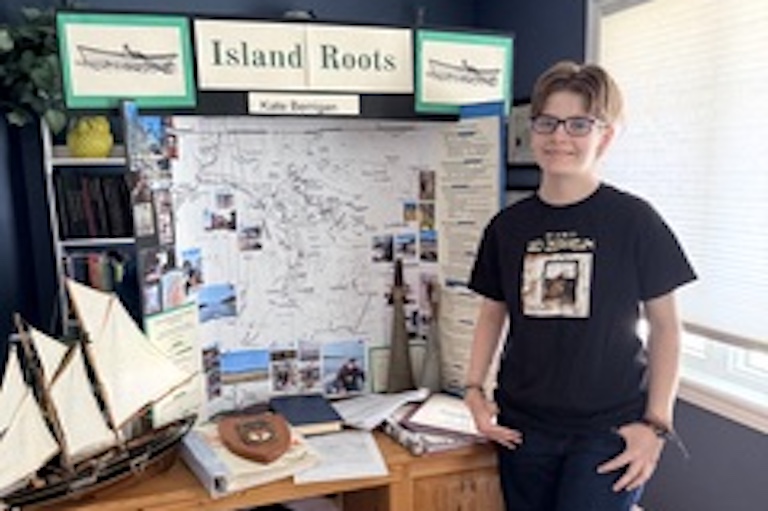
Island Roots
Kate B.
South Shore Regional Fair
Bridgewater, NS
My project focused on the history of the LaHave Islands and my family’s roots there. My father’s family lived on Middle Island and later Bell Island, where my grandfather grew up and attended school. Through interviews with my grandfather, great-uncle, and father, I learned about everyday life on the islands, including fishing, travelling by boat, surviving harsh winters, and how families depended on each other for support.
I also researched the wider history of the LaHave Islands, beginning with Samuel de Champlain landing at Cape LaHave, which marked an important part of early French settlement in Nova Scotia. Through genealogical research and land records, I traced my family history back seven generations. One important discovery was that my third great-grandfather, Will Berrigan, had been adopted after his father died young. This showed how island families cared for one another during difficult times.
My final response to my inquiry question was that life on the LaHave Islands has changed dramatically over time. The islands once supported hardworking fishing families living modest lives, while today many properties are vacation homes owned by wealthy seasonal residents. Even though life has changed, the stories and experiences of earlier generations remain an important part of Nova Scotia’s heritage.
What sources and evidence did you consult for your project? What different perspectives did they provide on your topic?
I used several types of sources for my project, including interviews with family members, property deeds, survey plans, historical books, family stories, and field visits to the islands. Oral histories from my grandfather and great-uncle provided personal memories and stories about daily life growing up on the islands. Land registry records and genealogical research helped confirm family connections across generations. Historical books and documents gave me information about early settlement and the broader history of the LaHave region. These different sources allowed me to compare personal experiences with documented historical evidence.
What is the historical significance of your topic?
The LaHave Islands are historically significant because they are connected to early European settlement in Nova Scotia. Samuel de Champlain’s arrival at Cape LaHave helped establish French exploration and settlement in the region. Later, English settlers and fishing families built communities on the islands after the expulsion of the Acadians.
The short-term impacts included the creation of isolated island communities where families relied heavily on fishing and one another for survival. The long-term impacts include changes to the population and economy of the islands. Today, many original island families have left, and expensive vacation homes have replaced many modest homes. This reflects larger social and economic changes happening in coastal communities across Nova Scotia.
Why did you choose this topic?
I chose this topic because the LaHave Islands are an important part of my family history and my own life. I visit the islands every year and have always heard stories about my ancestors and their experiences there. I wanted to learn more about my roots and preserve the stories of family members before those memories are lost.