Felix C. and Hudson B.
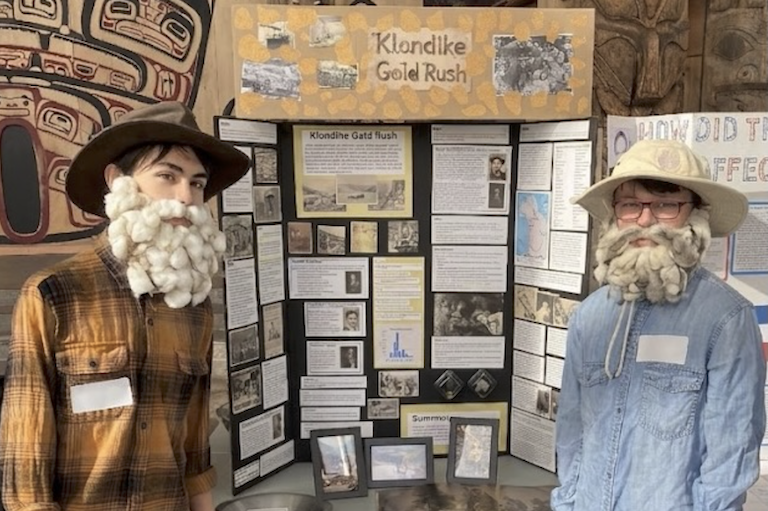
Klondike Gold Rush
Felix C. and Hudson B.
Ottawa Regional Heritage Fair
Ottawa, ON
The Klondike gold rush went from 1896-1899. About 100,000 people started the journey to the Klondike but only about 40,000 actually arrived – the rest turned back or died trying. Only about 400 people actually found enough gold to become rich. But there were lots of people who got rich by setting up businesses in the Klondike, such as saloons, hotels, gambling places and stores. Others got rich helping people get to the Klondike by steamship, train, and barge. In fact, a distant relative actually owned a tramline near Whitehorse – he was featured as a notable figure in our project. Other notable figures included Belinda Mulrooney, Jack London, Tappen Adney, and Skookum Jim and George Carmack (who made the first big discovery of gold that started the rush). Although the rush brought a lot of people in a short period of time, there was still law and order. Rules such as the “One Ton Law” – which required prospectors to have one ton of provisions to survive for a year – were enforced by the Northwest Mounted Police. Those going to the Klondike via the Chilkoot Pass needed to make at least 10 trips over the pass with their one ton of provisions. Mining for gold was hard work: the easiest way was panning or using a rocker box, but prospectors found more productive ways to extract gold using dangerous methods like shaft and drift mining. When the rush ended in 1899, most people left the Yukon. The gold rush had a lasting impact on the Yukon: the territory became more populated, writers and journalists raised awareness of the Yukon, it brought towns, rules and order, and the Yukon officially became a territory of Canada on June 13, 1898. Unfortunately, it also had a negative impact on the local First Nations.
What sources and evidence did you consult for your project? What different perspectives did they provide on your topic?
We consulted more than 20 different sources including books, websites and encyclopedias. To get the information about John Hepburn, the distant relative, we consulted the “Yukon Who is Who” website and we used stories about him that were shared with us by a family member. We used a lot of different sources because we wanted to tell a story with many different perspectives, including gold mining techniques, lifestyle, and travel to the Klondike.
What is the historical significance of your topic?
The gold rush is an example of what can happen when a lot of people show up in one place that is not ready for them. It can impact the economy, traditional ways of life, and the environment. We already wrote about the prospectors and business people who went to the Yukon and how they experienced the gold rush. But the effect of the gold rush on the First Nations is one area we would like to explore further. We know that there were 5000 Indigenous people in the Yukon at the start of the gold rush and many of them died because of diseases brought by people who came to the Klondike. The gold rush was good for some people but there were a lot of people who were not so successful or who did not get any benefits.
Why did you choose this topic?
One of us had a relative that was involved in the Klondike gold rush and we thought it was an overall interesting topic.