
Eve S.
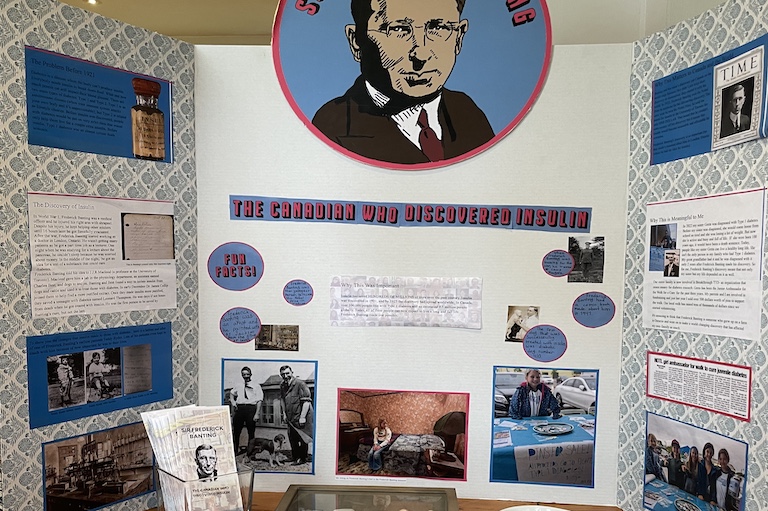
Sir Frederick Banting - The Canadian Who Discovered Insulin
Eve S.
District School Board of Niagara Heritage Fair
Welland, ON
In 2022 my sister Greta was diagnosed with Type 1 diabetes. Before my sister was diagnosed, she would come home from school so tired and she was losing weight. But today she is active and full of life. If she were born 100 years ago, it would have been a death sentence. I knew that insulin saved her life, and I wanted to learn more about how it was discovered and who was responsible. Through my research, I learned that diabetes is a disease where the body can’t produce insulin. Everybody needs insulin to break down food. There are two main types of diabetes: Type 1 and Type 2. 100 years ago, Diabetes was fatal. But after World War 1, Frederick Banting was working as a doctor in London, Ontario. One night when he was studying for a lecture about the pancreas, he couldn’t sleep and he got an idea for a test of a substance that could cure diabetes. Frederick Banting told his idea to J.J.R Macleod (a professor at the University of Toronto). Macleod gave him a lab, an assistant named Charles Best, and dogs to test on. They found a way to isolate insulin from dogs and cattle and used it to treat those with diabetes. Once they made insulin more purified, they saved a teenager with diabetes named Leonard Thompson. He was days from death before insulin saved him. He was the first person to be saved by Banting’s cure, but not the last. Insulin has saved HUNDREDS OF MILLIONS of lives over the past century. Banting’s discovery put Canada on the world stage because they didn’t just keep their discovery to themselves: they shared it with the world. In 1923, Frederick Banting won the Nobel Prize in medicine. The same year, he sold the patent for insulin to the University of Toronto for only ONE DOLLAR. Today, all diabetics with access to insulin can expect to live a long and full life. Including my sister Greta. And that is why Frederick Banting isn’t just a Canadian hero, but a hero to me as well.
What sources and evidence did you consult for your project? What different perspectives did they provide on your topic?
My bibliography included:
- The Biography of Sir Frederick Banting (1891-1941) - The Discovery and Early Development of Insulin - Explore collections of U of T (n.d.)
- The Canadian Encyclopedia (n.d.) -The Canadian Encyclopedia.
- Banting House National Historic Site(site visit - London, Ontario).
- The Discovery of Insulin (n.d.) -HistoricaCanada.
- Defining Moments Canada (2024 July 9), Insulin100 - Defining Moments Canada.
- MacLeod, E. (2025),Meet Frederick Banting(Scholastic Canada Biography).
- Maltman, G. (2026), Email with Curator of Banting House National Historic Site of Canada.
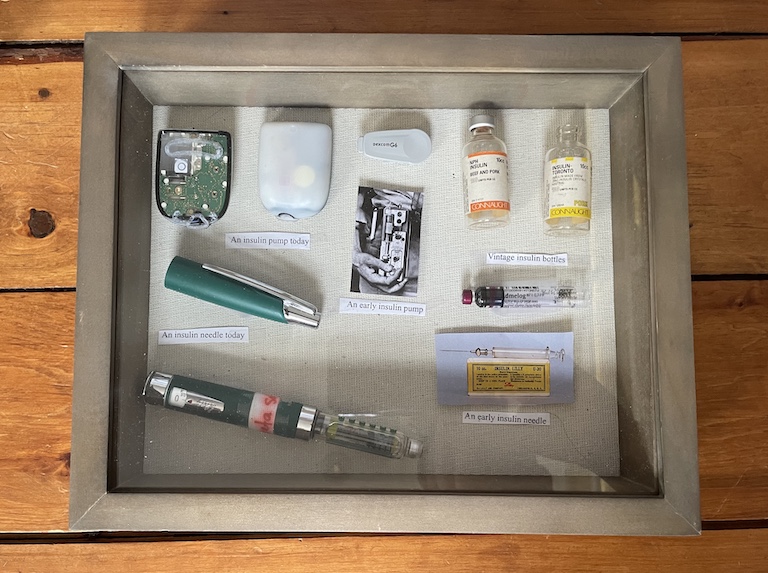
What is the historical significance of your topic?
Insulin has saved HUNDREDS OF MILLIONS of lives over the past century. Insulin was discovered in 1921, and by 1923 the discovery had spread worldwide. In Canada, over 300,000 people live with Type 1 diabetes and an estimated 9.5 million people globally. Today, all of these people can now expect to live a long and full life. Frederick Banting made that possible.
Why did you choose this topic?
I chose this project because my sister Greta was diagnosed with Type 1 diabetes four years ago. She isn't the only person in my family who had Type 1 diabetes. My great grandfather had it and he was diagnosed with it only 2 years after Frederick Banting made his discovery. So for me, Frederick Banting’s discovery meant that not only my sister but my life depended on it as well.