
Danyet S. and Shamira S.
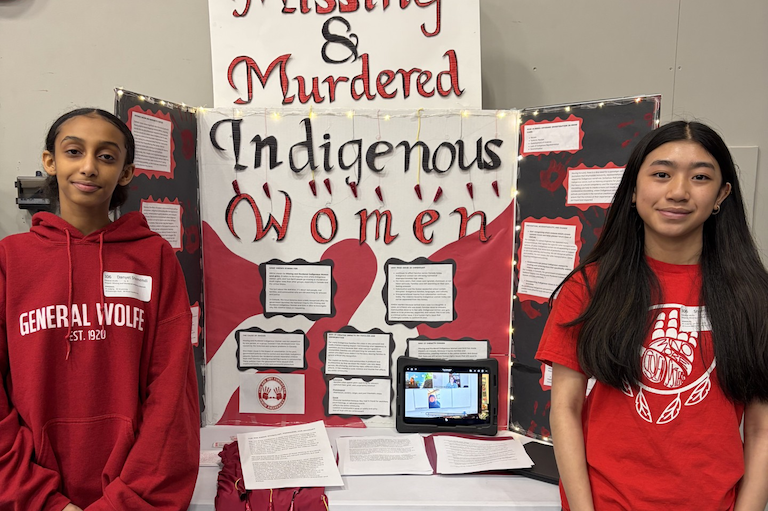
Missing and Murdered Indigenous Women
Danyet S. and Shamira S.
Historical Thinking Symposiusm
Winnipeg, MB
We looked at the reasons behind the national crisis of MMIW2S+ people in Canada and how systemic racism, colonization and bias in journalism continue to affect people today. We interviewed our local Member of Parliament, Leah Gazan; who is a consistent advocate for awareness and advocacy to the issue of missing and murdered Indigenous women and girls in Manitoba and across the country to find out what can be done to continue to raise awareness for this issue and how young people can get involved in this. We focused on some opportunities for learning and the hope that some of the small actions that have been taken; like Red Dress Day, the alerting system, and education have brought about change and forward movement to this issue. We hoped to encourage others to continue to address this issue and advocate for changes to bring about more change and improve the recognition that everyone deserves to be cared for no matter who they are.
What sources and evidence did you consult for your project? What different perspectives did they provide on your topic?
We interviewed our local Member of Parliament, Leah Gazan, who works in Parliament to advocate for the rights of women and families. She is also an Indigenous women who has a primary connection to the topic. We also used sources from organizations from Amnesty International, the Human Rights Museum and advocates like Jaime Black.
The sources allowed us to look at information from different angles and perspectives that we might not have heard from before. It was important to interview and learn from Indigenous people as they have been most affected by this issue.
What is the historical significance of your topic?
Missing and Murdered Indigenous Women and Girls (MMIWG) is important because it is not just a problem from the past, it is something that continues to affect families across Canada today. Indigenous women are still being harmed at disproportionately high rates. For many years, their cases were ignored, dismissed, or not taken seriously. Families were left searching on their own, feeling unheard.
This issue is deeply connected to Canada’s history. Colonization and the Indian residential school system disrupted Indigenous families, languages, and cultures. The trauma caused by these policies did not simply disappear when the residential schools closed, it has continued to affect communities through intergenerational trauma. The violence faced by Indigenous women today can not be separated from this history.
MMIWG2S+ matters because behind every case is a daughter, a sister, or a friend who was loved. Families deserve answers. Communities deserve to feel safe. Indigenous women and girls deserve to be protected, respected, and valued. This is not only a criminal justice issue, it is a human rights issue that challenges Canada to confront its past.
The impact of MMIWG2S+ on communities is deep and lasting. Indigenous women are often at the center of family and cultural life, so when they are lost or missing, communities lose leaders, and future generations. It creates fear, grief, and distrust. Over time, that can weaken a community’s sense of safety and unity.
Some changes that have been made are: more education in schools, training for media and police when handling these issues, honouring Red Dress day and the inclusion of the National alert system when and Indigenous women or girl goes missing. There is also the National Inquiry into MMIWG2S+ and the work being done to include more Indigenous voices in decision making, as well as continued work with Indigenous people to understand and combat systemic racism and the reinforcement of Indigenous culture in schools and communities
Why did you choose this topic?
We chose this topic because it is an important issue that affects many people in our school community and in our country. We wanted to highlight why this continues to be an issue in Canada, the reasons for the mistreatment of Indigenous women and girls and look at what can be done to improve this in the future so more people are not affected. We want people to see that we are all part of Canada and need to work together to bring about change and recognize the importance of one another.
Both of our families immigrated to Canada and had heard many of the stereotypes against Indigenous people. By learning more about the issue, we can teach others to be open to change and help spread positive awareness of the issue so that more newcomers get an accurate picture of the situation in Canada and how we can work together to build a stronger future.