
Daniyal K.M.
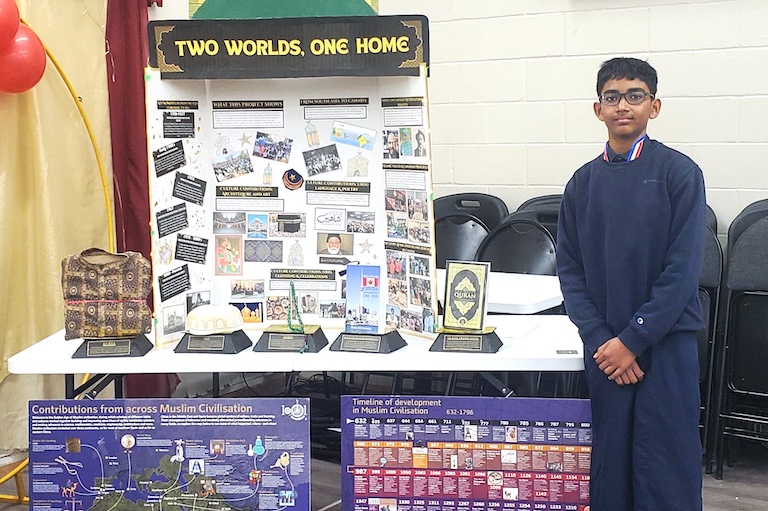
Two Worlds, One Home
Daniyal K.M.
Durham Region Heritage Fair
Whitby, ON
My project tells the story of a heritage that began in South Asia, where Islamic beliefs blended with Indian, Persian, and Central Asian traditions to create a unique cultural identity. When Indo‑Muslims migrated from India, Pakistan, Bangladesh, and Sri Lanka to Canada, they carried this heritage with them. Many arrived seeking education, opportunity, or safety, and although they faced challenges such as racism, language barriers, and unfamiliar environments, they built strong communities that helped preserve their traditions. Families, scholars, artists, and volunteers became key figures in shaping Indo‑Muslim life in Canada.
I explored how Indo‑Islamic architecture introduced domes, arches, minarets, and geometric patterns to Canadian cities, and how Urdu poetry and language enriched Canada’s artistic and linguistic landscape. Foods like biryani, kebabs, and chai became part of Canadian culture, while celebrations such as Eid created opportunities for interfaith connection. I also examined how Islamic values such as zakat (charity), adl (justice), and rahma (compassion) align with Canadian principles of fairness, equality, and community service.
My final response to my inquiry question is that Indo‑Islamic heritage has significantly shaped Canada’s multicultural identity by contributing art, language, food, celebrations, and values that promote inclusion, generosity, and cultural understanding. This heritage continues to grow, helping Canada become a more diverse and compassionate society.
What sources and evidence did you consult for your project? What different perspectives did they provide on your topic?
I used a combination of primary and secondary sources to build a complete understanding of my topic. My primary sources included interviews with Indo‑Muslim community members, photographs of mosques and cultural events, and personal family stories. These sources gave me authentic, lived perspectives from within the community. My secondary sources included books, academic articles, documentaries, museum archives, and reputable websites, which helped me understand historical context, migration patterns, and cultural development. Comparing these sources allowed me to see which voices were centred, which were missing, and how different perspectives shaped the story of Indo‑Islamic heritage in Canada.
What is the historical significance of your topic?
Indo‑Islamic heritage is historically significant because it shows how migration shapes national identity. In the short term, Indo‑Muslims introduced new foods, languages, celebrations, and architectural styles to Canada. In the long term, they helped build multicultural values, community institutions, and interfaith relationships that continue to strengthen Canadian society. Their contributions affected millions of Canadians by promoting diversity, cultural understanding, and shared values such as charity, justice, and compassion. This heritage demonstrates both change and continuity which shows traditions adapted to a new country while still preserving their roots. It also highlights cause and consequence, showing how migration decisions led to lasting cultural impacts on Canada.
Why did you choose this topic?
I chose this topic because Indo‑Islamic heritage is part of my identity, but also because it’s a story I live every day. When I hear Urdu poetry at family gatherings, when we celebrate Eid with our community, or when I see the architecture of a Canadian mosque that reminds me of South Asia, I feel connected to a history that travelled across continents. I wanted to understand how these traditions came to Canada and how they contribute to the country I call home. This project allowed me to honour my family’s story while also showing how Indo‑Muslims help shape Canada’s multicultural identity.