
Danica D.
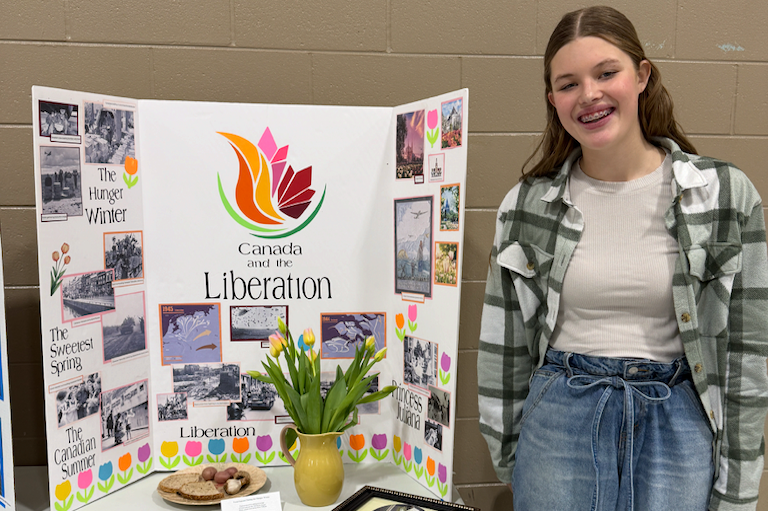
Canada and the Liberation of the Netherlands
Danica D.
Ontario Independent Fair
Virtual
Canada’s courage with the liberation of the Netherlands from Nazi occupied Europe ultimately created a lasting friendship between Canada and the Netherlands. Canada joined the war in 1939 and became a strong military force with over 1.1 million people in the Canadian Army. The First Canadian Army formed in 1942 and they fought through France and Belgium, before entering into the Netherlands. Despite heavy casualties and difficult conditions, they helped push the German forces back in a big way.
By 1945, the Dutch people were suffering from starvation and heavy destruction, especially during the “Hunger Winter.” Canadian troops and other Allied forces provided crucial food and aid through many operations like Manna, Chowbound and many more. Canadian soldiers fought through muddy and flooded terrain, eventually helping secure a truce with the Germans to allow food deliveries to millions. In May 1945, German forces in the Netherlands surrendered.
During all this the Dutch royal family was evacuated to Ottawa, where they lived for 5 years and Princess Juliana had a baby, Princess Margriet. The Canadian government had to make her rooms in the Ottawa hospital extraterritorial in order for the baby to be born on Dutch soil to keep her in the Dutch Royal Line.
After the war strong bonds were formed. The Dutch sent tulips to Canada - a symbol of gratitude and it led to Ottawa’s annual tulip festival. The liberation showed the impact of Canada’s courage, created a lasting legacy, and deepened the friendship between Canada and the Netherlands. The powerful connections with the desperate Netherlands and Canada paid the heavy price and sacrifice while liberating the Netherlands, forming bonds of friendship and respect between the two nations. Today all countries should look at Canada and the Netherlands for modeling global relationships, partnerships and friendly collaboration.
What sources and evidence did you consult for your project? What different perspectives did they provide on your topic?
Using both of my primary and secondary sources helped me understand and answer most if not all my questions including my inquiry question. The primary sources I found and used, I wove into my report and used on my board. Most of my pictures and newspaper articles were primary sources and helped me understand what it was like during the actual war and most of them showed the emotions, struggles, challenges and real life experiences for the Canadian Soldiers and Dutch people faced at the time it happened. Secondary sources like websites and book sources help explain the rest, with more background information, Canada’s role in WW2, how the Liberation happened and the lasting impact as a whole. With both of the sources I was able to get a complete picture and understanding of Canada and the Liberation of the Netherlands.
What is the historical significance of your topic?
Canada and the Liberation of the Netherlands is significant to Canada’s history, because the lasting impacts are still mostly in effect today. The Liberation created a lasting impact in the friendship between the 2 countries, and all countries should look at Canada and the Netherlands as a model for global relationships, partnerships and friendly collaboration.
Why did you choose this topic?
When I chose the topic of Canada and the Liberation of the Netherlands, I had been looking for a topic for a long time. I went through list after list on line trying to find one that sparked my interest. When my mom told me about this topic, it sparked my interests. It was a topic that was close to my heart because my mom is a florist and her side of the family runs greenhouses. My family is also Dutch on both sides so I could learn more about why the Dutch and the Canadians have such a good relationship with each other and how this is one of the main reasons why there are so many Dutch here in Canada today.