
Cole D.
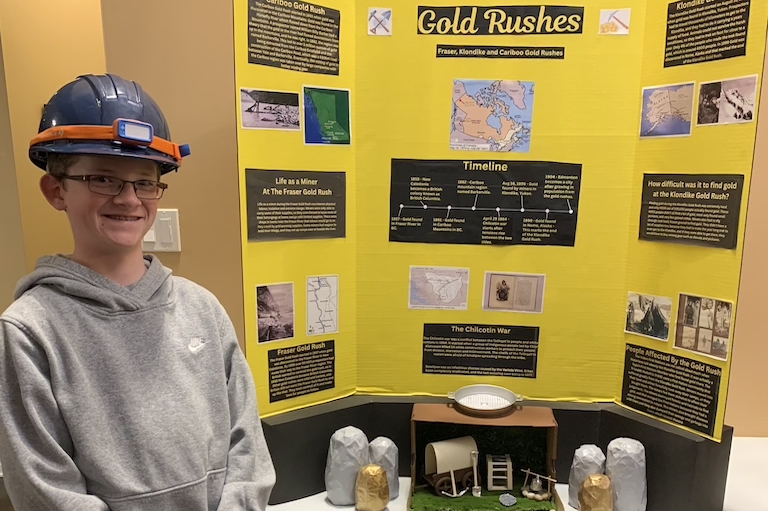
Gold Rushes
Cole D.
Thames Valley Regional Heritage Fair
London, ON
This first started in 1857, when gold was found in the Fraser River in New Caledonia. This was the first major gold rush in Canadian History. This made the British decide to make New Caledonia a British colony known as British Columbia. Then in 1861, gold was found in the Cariboo Mountains in British Columbia. Originally, the gold was found in the Horsefly River which flowed down from the mountains, but a man named William Billy Barker had a theory that the gold had flowed down from the mountains in the river, and he was right. That discovery led to over 5 million ounces of gold being extracted from the Cariboo Goldfield. In 1864, a group of construction workers were building a road to the Cariboo Goldfields when they were attacked and killed by a group of Indigenous peoples led by Chief Klatssassin. The Indigenous did this to protect their people from disease, starvation, and mistreatment. Finally there was the Klondike Gold Rush, which was the last major gold rush in Canadian history up to this date. It started on August 16, 1896 when gold was found in Klondike Yukon. Miners had to dig through thick, frozen ground to get to the gold, and only 4% actually found gold.
My final response to my inquiry question was that cruel things happened during these gold rushes such as the killing of the 14 construction workers, and miners taking Indigenous land for themselves. These gold rushes greatly affected Canadian History including the changing of New Caledonia to British Columbia and the history of Edmonton. Edmonton became a city because it grew in population from the gold rushes. Finally, the history of Dawson City. Dawson City was right near the Klondike gold rush, and it was a crucial trading area for miners.
What sources and evidence did you consult for your project? What different perspectives did they provide on your topic?
All of my information was obtained from trusted websites and paper readings that were supplied by my teacher. Though they didn’t really put different perspectives on my topic, they greatly helped me understand what happened during these gold rushes.
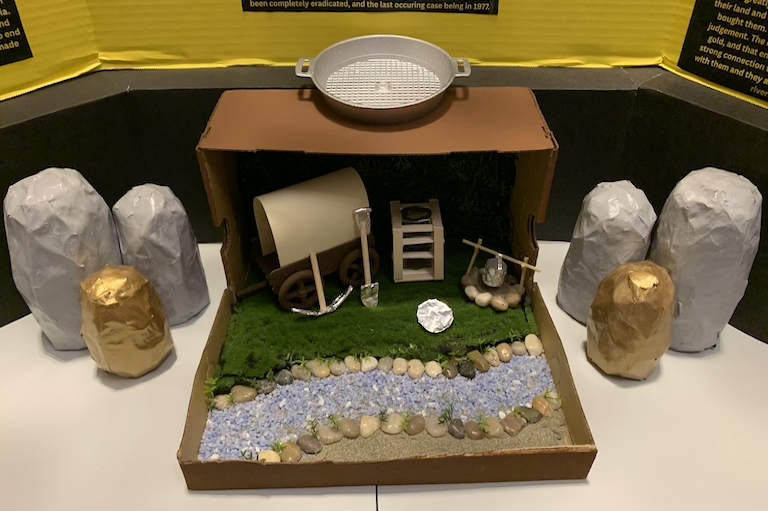
What is the historical significance of your topic?
Some long-term impacts were that Edmonton was not a city until 1904 when it grew in population from the gold rushes. British Columbia was New Caledonia, but it became BC because of the Fraser Gold Rush. Short-term impacts were when diseases spread throughout Indigenous tribes and camps as well as Dawson City during the Klondike Gold Rush. Those diseases eventually got cures and vaccines. Smallpox was very common then, but it has been completely eradicated with the last occurring case being in 1977.
The people who were mainly affected during these gold rushes were the Indigenous Nations in and around the areas where the gold rushes were. Their camps were taken away and disease was spread through their Nations, killing many. The main changes that took place were Edmonton becoming a city and New Caledonia becoming British Columbia.
Why did you choose this topic?
Originally, I was in a group of two with our topic being African Canadians. My teacher told us that if we got picked to go to regionals, only one of us would get to go. We both wanted to go if we got the chance, so we decided to split up, and I let him have African Canadians for his topic while I chose a different one. Gold Rushes had been my second choice if African Canadians had been picked, and I already knew some things about it from past years. I was in a 7\8 split last year, and during history classes, the grade eights would be learning about these gold rushes. So I learned some things that way, and I also had a really good idea for a diorama, so that's why I chose the topic Gold Rushes.