
Benjamin D.
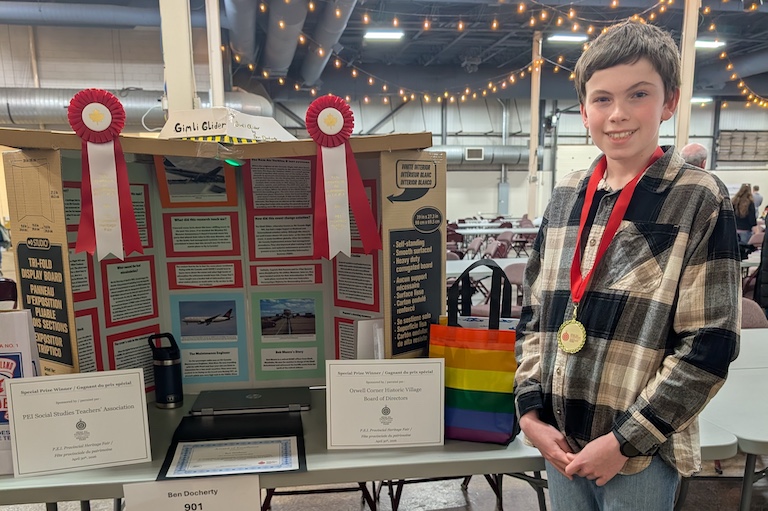
The Story Of Air Canada Flight 143 - The Gimli Glider. A Near Disaster After Fuel Ran Dry.
Benjamin D.
Prince Edward Island Heritage Fair
Charlottetown, PEI
Air Canada Flight 143 departed Montreal Pierre Elliott Trudeau Airport (CYUL) at approximately 5:48PM ET, though that airport was formerly named Dorval International. During Canada's switch from imperial to metric, a miscalculation was made during the refueling process. 22,300 kilograms of jet fuel was the required fuel amount, however, the ground crew at YUL instead put 22,300 pounds of jet fuel in the tanks, which was 45% of the fuel quantity required. The Boeing 767-200 was brand new at the time, and was feature packed with modern computerized systems, which eliminated the need for a third cockpit crew member. The Fuel Quantity Information System (F.Q.I.S.) was malfunctioning at the time of the incident, which means that the pilots, Bob Pearson and Maurice Quintal, had to make manual fuel calculations in which they were under-trained. Flight 143 landed for their planned stopover flight in Ottawa (CYOW) at 6:58PM ET. The pilots determined that another refuel was not necessary, after just one hour of flight time.
While cruising above 40,000 feet over Red Lake, Ontario, cockpit warning lights illuminated for low fuel pump pressure. During this moment, an Air Canada maintenance engineer named Rick Dion was visiting the flight deck. However, Dion was not trained on the Boeing 767, so he couldn't offer much advice. As each engine spooled down one after the other, Pearson and Quintal learned the jarring truth that there was never enough fuel to be pumped. A diversion effort to Winnipeg was made, but after Quintal's math proved they would not make it, Pearson had to act fast. In prior years to the event, Pearson was a glider pilot, and Quintal trained in the R.C.A.F at Gimli. A near perfect scenario had lined up amongst the dire situation.
Gimli Manitoba is a small town 90 kilometers north of Winnipeg. In 1971, R.C.A.F. Station Gimli was decommissioned as an air force base, and turned into a race car strip. Although one runway was still open for small, private aircraft, Pearson lined up for the makeshift drag racing strip. As the airplane touched down at over 200 kilometers per hour, the front landing gear hadn't locked due to a lack of hydraulic pressure. As a result of this, the front landing gear collapsed after roughly 200 feet from initial contact according to eyewitness and retired R.C.M.P. officer Bob Munro. During a two-hour long interview that I arranged with Munro, I learned many of the key facts from this story that helped me put this project together. A bone chilling moment occurred, as two children were riding their pedal bikes down that same runway. As the Boeing 767 barreled down the asphalt, Pearson and Quintal saw them. In a Mayday Air Disaster interview with Pearson, he claimed that if the aircraft didn't stop in time, he would have steered it off the runway with the rear brakes in order to save the children. In conclusion, all 61 passengers and 8 crew members survived the near disaster.
To this day, the Gimli Glider story keeps millions of air travelers safe from the regulations that were put in place after the incident. I made this project to share the story with my generation, to keep the topic alive. I consider my inquiry to be a success, as I went far past web articles to find the facts that I so dearly wanted to learn about Air Canada Flight 143.
What sources and evidence did you consult for your project? What different perspectives did they provide on your topic?
I first learned of the story from the Canadian television show Mayday Air Disaster. I began my research by watching the specific Season 5: Episode 2 documentary over five times! I e-mailed the Royal Aviation Museum to see what information that they had for me, and I got a response from museum worker Wayne Adams. "While the Royal Aviation Museum of Western Canada does have some information on the history of this event on July 23, 1983, the best source of detailed information would be to contact the Gimli Glider Exhibit people in Gimli Manitoba." I took the e-mail that he gave me, and contacted the Gimli Glider Exhibit. I asked in the e-mail if they had any knowledge of real eyewitnesses of the event. Though I did not get a direct reply from them, two weeks later I received an email from a retired R.C.M.P. officer and eyewitness, Bob Munro. "Ben, I thank you for keeping the story of the Gimli Glider alive. I was the RCMP member in charge of the Gimli Detachment and by chance was on the north end of the airport and witnessed the glider landing and of course assumed control of care of the passengers and crew as well as the aircraft. I suggest researching the book "Freefall" written by William and Marilyn Hoffer. My part in the incident as well as the majority involved is very well documented. I suggest the book as the information was gathered not long after the landing and while memories were fresh. Good luck in your research."
What is the historical significance of your topic?
The topic that I chose, the Gimli Glider, is a very significant event in Canadian History.
In the short-term (first days post-incident), everyone involved experienced delays. The aircraft had to undergo major inspections and repairs, which cost Air Canada time, money, and resources. All of the passengers had to reschedule their flights with the airline, which delayed their plans in Edmonton. The pilots of Air Canada Flight 143 could not return to work until the investigation was complete.
Although short-term effects were inconvenient and costly, long term effects were beneficial with new aviation safety protocol. The F.A.A. initiated standards that required all pilots to be trained on flying with zero engine power. The new regulations also required commercial pilot training to include manual fuel calculations and awareness on unit adoption, such as conversions between imperial and metric. Though there haven't been many related aviation incidents to Flight 143, the changes that it has made has for sure prevented worse ones. The final changes that I have researched are the maintenance procedures for flight computer systems that were used by Boeing. Had the Fuel Quantity Information System (F.Q.I.S.) been working properly that day, and well maintained, this whole event may not have happened. If the changes from this incident weren't made then, a much worse accident could have occurred. This event was a silver lining moment for all of the aviation industry.
Why did you choose this topic?
I chose this topic because I enjoy aviation history. I learned about this particular story while watching the Mayday Air Disaster documentary, which immediately caught my attention and curiosity.