
Axton B.
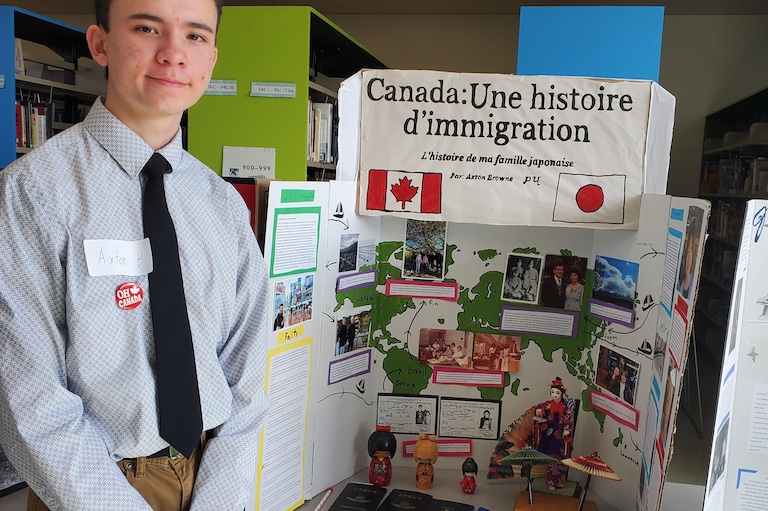
Canada: A History of Immigration
Axton B.
Anglophone West School District Regional Heritage Fair - Fredericton
Fredericton, NB
Today, 23.5% of Canada’s population is made up of immigrants. As of 2021, about 8.3 million immigrants were permanent residents of Canada. Although immigration levels have changed over time because of events such as World War I, World War II, and the Great Depression, more than 17 million people have immigrated to Canada. Like many Canadians, my mother’s side of the family has an immigration story.
My family’s journey began with my great-great-grandfather, who was born in Kin, Okinawa, Japan, in 1890. He immigrated to Canada with his family in 1910. His son, Seitoku Nakada, was born in Japan and served as a student soldier during World War II. After the war, he married Sumiko Nakada, and they had my grandfather, Toshihiko Nakada, in 1948. At age 16, my grandfather moved to Canada with his family because Seitoku’s siblings were still living there. While Seitoku was away, his siblings had been forced into internment camps and lost nearly everything.
My grandmother, Yukie Martha Nakada, was born in Naha, Okinawa, in 1952. Her family moved to Bolivia when she was five and later to Brazil in search of better opportunities. In 1977, my grandfather visited Brazil, and soon afterward my grandmother immigrated to Canada with him.
Major historical events shaped my family’s experiences. During World War I, Canada and Japan were allies, encouraging Japanese immigration to Canada. However, discrimination persisted, and during World War II nearly 23,000 Japanese Canadians were placed in internment camps. Many lost their homes, businesses, and belongings.
My family’s story reflects both the opportunities and hardships faced by immigrants. Like countless others, their journey helped shape Canada into the diverse country it is today.
What sources and evidence did you consult for your project? What different perspectives did they provide on your topic?
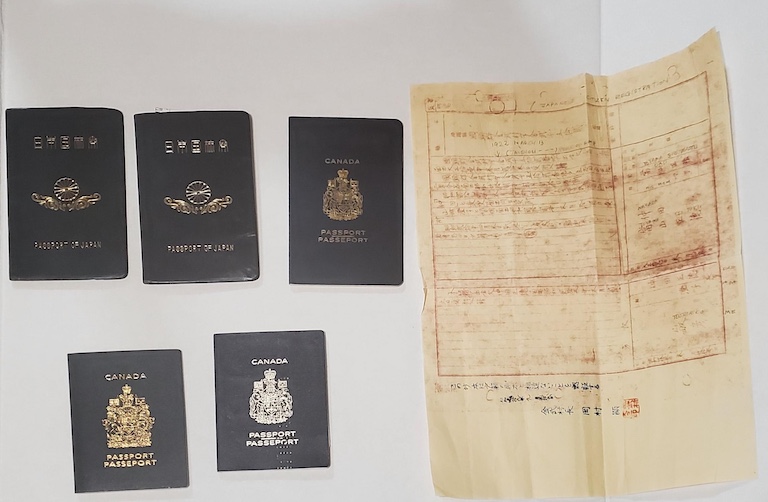
The main source of my research were my grandparents, Toshihiko and Yukie Nakada. I interviewed them. Also included are passports, Japanese registration papers and photographs.
Statistics and historical facts were from:
- https://www.thecanadianencyclopedia.ca/en/article/internment.
- https://www.britannica.com/list/timeline-of-world-war-i.
- https://www.canada.ca/en/library-archives/collection/research-help/genealogy-family-history/ethno-cultural/japanese-canadians.html.
- https://www.loc.gov/classroom-materials/immigration/japanese/hawaii-life-in-a-plantation-society/.
- https://americanhistory.si.edu/explore/exhibitions/more-perfect-union.
These sources gave me insight into how Japanese families were affected by WWII in Canada, their experiences in internment camps, and how immigrants impacted Canada as a whole. The source that changed my perspective the most was the interview with my grandparents. The interview gave me more insight into my family’s history and was the most impactful piece of information that I received during the whole project.
What is the historical significance of your topic?
Canada is a nation shaped by immigration. This topic is significant because much of Canada's population consists of immigrants or the children of immigrants. Throughout history, people from around the world have chosen to make Canada their home, transforming communities and helping define the country's identity. In the short term, immigration has helped create jobs, support economic growth, and brought new perspectives to communities across the country. In the long term, Canada has grown its economy, culture, education, and strengthened our multicultural identity. Canada's population has grown by millions, bringing hundreds of thousands of new workers and introducing Canadian society with a wide range of traditions, languages, and experiences. Countless individuals, families, and communities have been changed by the stories and contributions of immigrants, making immigration one of the most important topics in Canada's development.
Why did you choose this topic?
I chose this topic so I could better understand who I am and how my Japanese heritage influenced my identity. I wanted to learn about my family’s history, and why my grandparents chose to immigrate to Canada. After learning more, I wanted to choose this topic to better understand how historical events impacted other immigrant families, too.