
Avleen G.
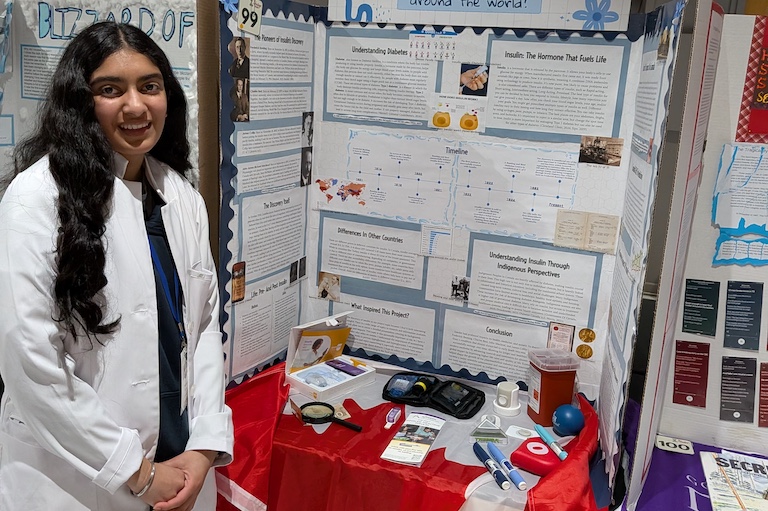
Discovery of Insulin
Avleen G.
District School Board of Niagara Heritage Fair
Welland, ON
In October 1920, Canadian doctor Frederick Banting was preparing a lecture on the pancreas when he read about the islets of Langerhans, which control blood sugar. He believed that if he could isolate their substance, something could happen. Despite rejection, he went to the University of Toronto, where Macleod provided a lab, equipment, dogs, and an assistant, Charles Best. They surgically removed the pancreas from dogs, causing them to become diabetic and lose weight. They took the pancreas from healthy animals, closed the ducts so most tissue would break down while leaving the islet cells intact, and crushed the remaining tissue into an extract. After filtering, they injected the liquid into the dogs. Their blood sugar levels dropped, and their condition improved, temporarily, since the extract was impure. James Collip purified the extract, making it safe for humans. In January 1922, they treated Leonard Thompson, a 14-year-old boy dying from diabetes. The injection caused a reaction, but after further purification, a second dose improved him, making this the first successful human test. They sold the patent for $1 so it could be widely available. With the help of companies, insulin was mass-produced, saving millions of lives.
Insulin had profound impacts on health, medicine, and society. The discovery changed diabetes from a condition that almost always led to early death into one that people could successfully manage over time, allowing for longer and healthier lives. It moulded modern medicine by advancing research and treatments for chronic diseases. It had a global impact by improving life expectancy and quality of life. Economically, insulin helped shape the growth of the pharmaceutical industry and innovation. In Canada, it became a national pride. However, its benefits have not been equally experienced, as Indigenous peoples and other communities still face challenges with access and healthcare equity.
What sources and evidence did you consult for your project? What different perspectives did they provide on your topic?
For my project on the discovery of insulin, I used a variety of sources, including videos, books, the University of Toronto website, the Government of Canada website, and other medical clinic websites. These sources helped me understand both the scientific discovery and the historical importance of insulin. The evidence from these sources included facts about how insulin was discovered and the experiments done so that it could be used safely as a treatment. The videos made the process easier to understand by showing it visually, while the websites gave timelines, background information about diabetes, and how insulin is used today. The sources gave different perspectives on the discovery. Some focused mainly on Banting and Best as the key discoverers, while others explained that the discovery was actually a team effort involving Macleod and Collip as well. By comparing these sources, I learned that insulin was not discovered by just one person but through teamwork and shared scientific effort.
What is the historical significance of your topic?
The discovery of insulin is one of the most important medical breakthroughs in history because it transformed diabetes from a condition that almost always led to early death into one that people could successfully manage over time, allowing for longer and healthier lives. Before insulin was discovered in 1921, many people with Type 1 Diabetes, especially children, had very little chance of surviving for long after being diagnosed. They were often put on strict starvation diets to try to control their symptoms. The work of Frederick Banting, Charles Best, John Macleod, and James Collip led to a treatment that saved lives almost immediately. People who had been extremely sick were able to regain their strength and live much longer. Over time, insulin allowed millions of people with diabetes to live normal, productive lives instead of facing an early death. Families of people with diabetes felt more hopeful and reassured knowing their loved ones could receive effective treatment. Starvation diets were no longer necessary, and people with diabetes gained much more freedom in their daily lives, including greater flexibility in what they could eat. The discovery also led to new research on hormones and disease treatment, helping medicine advance in many other areas. It affected people with diabetes, their families, doctors, and researchers around the world. Overall, the discovery of insulin had both immediate and long-lasting effects, improving the lives of millions and changing the way diabetes is treated today.
Why did you choose this topic?
I chose the discovery of insulin as my project topic because I find it both interesting and meaningful. There is a wide range of topics to research and information available. This will allow me to create a detailed presentation covering its background, development, and impacts. This topic is also personally important to me, as I have a family member who relies on insulin. I understand the importance of maintaining proper glucose levels to prevent hypoglycemia and hyperglycemia. I am passionate about this subject and enjoy researching it, especially since I already have some background knowledge about diabetes. I hope to reflect my interest and understanding in the final project.