Autumn L.
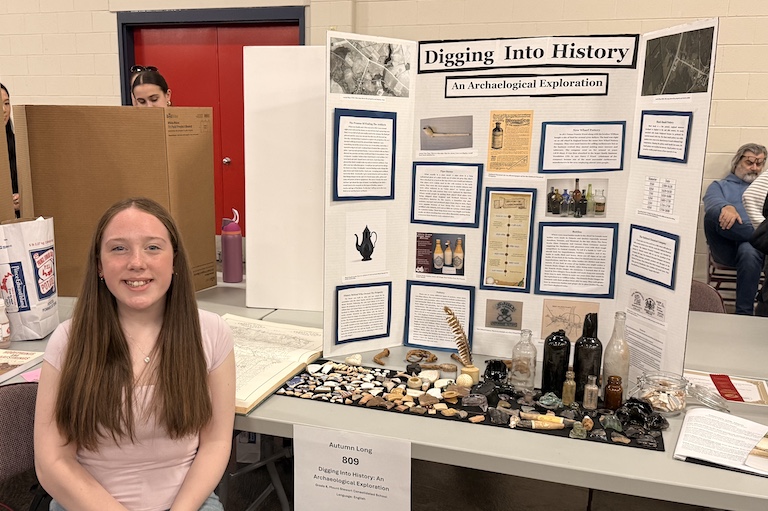
Digging Into History: An Archaeological Exploration
Autumn L.
Prince Edward Island Heritage Fair
Charlottetown, PEI
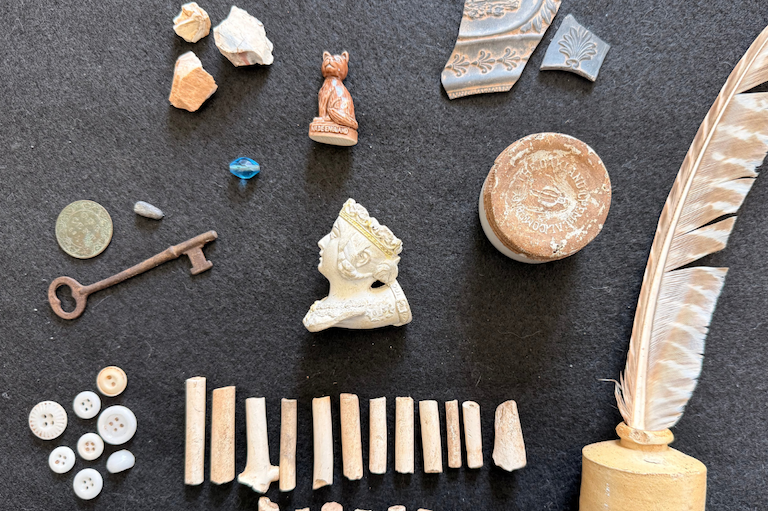
The field behind my house is home to hundreds of artifacts, and I've been uncovering them over the past four years. I haven't just been looking in the dirt either. I’ve interviewed a former landowner, a village resident and I even met up with a real archaeologist! She taught me so much about my artifacts and where they came from. I've found everything from porcelain to earthenware, pipe stems to buttons, whole bottles to metal spikes, and much more. I've researched makers marks that were on shards of pottery, writing on old bottles, what penny pipes are, and what they were used for.
Through my research I was able to learn where some of the artifacts came from and created a timeline of how old they may be. I've researched all about who owned the property before me all the way to the 1700s. I learned about the different types of pottery and many companies that would have supplied porcelain and fine china like the pieces I've found. I learned how to date artifacts from an archaeologist. The list goes on and on.
My project isn't just a display of things I dug up, it's a real representation of what Canadians in the eighteen hundreds used and how they lived. My project shows that history isn't just in the books, it's right below our feet.
My main inquiry question is how the artifacts got there and why they are there, which is something I've wondered ever since I found that first piece of pottery.
I spent this project learning about my artifacts where they came from and why those artifacts were there. Alison Rose was a key aspect in finding out why those artifacts might've been there. In my interview with him he said: “Some could be simply lost or misplaced items that got plowed under many years ago.” He also stated: “Years ago there was no waste watch or community dumps for that matter and garbage was thrown under a tree or in an out of the way spot.” This helped me gain so much context as to why the artifacts were where I had found them.
Most of my pottery had been located closer to the property which indicated a possible dumping ground. The interviews were a critical element in answering my inquiry question. I don't necessarily think I can give just one answer to my inquiry question because there's an endless amount of possibilities as to why the artifacts were deposited over the 100s of years by many different individuals.
What sources and evidence did you consult for your project? What different perspectives did they provide on your topic?
For my heritage project I used many primary and secondary sources. For my primary sources I interviewed the grandson of the previous owner, Alison Rose, who spent much of his youth on the property. I also interviewed Bloyce Affleck, a village resident and a local town historian, who purchased a parcel of the land from the Roses.
My interviews helped me connect real stories to my artifacts which helped me to gain context on where the artifacts came from and why they might've been there in the first place.
I also spent time with Hadeya Okeafor, an archaeologist, who I was able to share my collection with. I gained an unbelievable amount of knowledge from her, which was invaluable. Together we were able to categorize them into two separate deposits. Most of my pottery and other artifacts were primarily from the 1800s -1930s, left there primarily by English settlers, but she pointed out a few pieces that she suspected to be French, circa 1700’s who inhabited the area before the land lottery in 1767. The archaeologist helped me make a timeline for my artifacts rather than making educated guesses.
I consulted the 1870s Land Ownership Atlas which gave me a better idea of what the land looked like, as well as aerials from the 1930s. I used various websites and searches to help me identify artifacts, but most of my information came from https://thecanadianencyclopedia.ca/en as well as https://www.nationaltrustcollections.org.uk/. I felt like I got the most value from my interviews and speaking with archaeologists. I am so incredibly grateful that I was able to speak to those people and that I got the chance to learn more about my artifacts.
What is the historical significance of your topic?
Every artifact I have displayed today has historical significance, each artifact tells a small part of history, for example the New Wharf Pottery Company. I had found a piece of pottery with just a few letters on it. After a lot of research, I was able to read about who founded the company, how long it was in business, and how it came to be in Prince Edward Island. Each artifact acts as a window into Canada in the seventeen and eighteen hundreds. It shows how people lived, and traded, how they worked, and made a living. It speaks to how items were shipped across the world, and the materials used to make them in a world before plastic. The artifacts that I've found in my field show how the materials in the last 100 years have changed as well as the craftsmanship. Most bottles, plates, and cigarettes are mass produced in the current era, meaning the quality doesn't compare to 100 years ago. The porcelain that I've found is delicate and the designs are so much more intricate than what is produced today.
Why did you choose this topic?
When I was 8, I moved from Calgary, AB to Mount Stewart, PE, into our 1860’s farmhouse. I didn't know much about the house, or the history of the property. One day, to get to know the property a bit better, I decided to explore, hoping for an adventure. While I was walking, I came across something glinting in the sun. I started to inspect it when I realized that it looked like a shard of plate. I had no idea that this moment would spark such a strong interest in archaeology and all things old. I rushed home to show my parents, and they confirmed it was pottery!
After that moment I continued to look in the field. At first, I was only finding bits of pottery but as the years went on, I started finding different things like pipe stems, buttons, whole bottles, metal spikes, and so much more. Year after year my collection increased so did my curiosity.
I began researching the items I was finding, to figure out how old they may be, where they came from, and how they could have possibly ended up in my field. After finding that first piece of pottery, something inside me clicked. I had found something that I loved. There was something about the thrill of finding new things. It was like being a detective and finding clues to a puzzle.
I chose this topic so I could share my greatest passion, to teach people, and to showcase everything that I've learned.