
Arushi A.
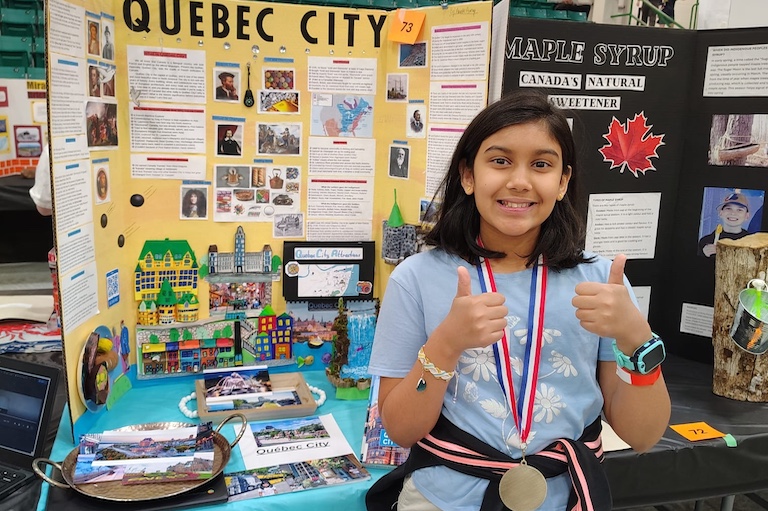
Quebec City
Arushi A.
Cape Breton Victoria Regional
Sydney, NS
Jacques Cartier, a French maritime explorer, came to Canada in 1534, 1535, and 1541 to find valuable treasures. From the European point of view, the place is now “Canada” had just been discovered. It was actually land inhabited by the Indigenous for thousands of years. He also named Cap Diamant and Canada too! Samuel de Champlain, a French explorer, set up a trading post in 1608. He also founded Quebec City. Many things were traded with the Indigenous and settlers. Later, many battles and historic events took place. The English attacked the French in 1690 and again in 1711. The “French and Indian War” in 1754, turned into the “7 Years War” in 1756. The legendary Battle of the Plains of Abraham took place in 1759. The Treaty of Paris in 1763, led to the British colony “Province of Quebec”, to exist from 1763 to 1791. The Quebec Act of 1774 was one of the many actions that sparked the American Revolution. The American Revolution took place in 1775 and they won their War of Independence. In 1791, Quebec City became the capital of Quebec. The St. Lawrence River, the finest way into North America, became a bustling port during the Napoleonic Wars. Great Britain and other parts of the world bought lots of timber from Canada, which made Quebec City very rich. Quebec City is also known for its famous fortified walls. Lord Dufferin led a campaign to save the walls of the city, which were threatened to be demolished. His goal was to rebuild the old walls into new ones. So, to this very day, Quebec City remains the most historic city in Canada, with 4 to 4.3 million tourists every year. With its beautiful streets, full of fun attractions, and history in every turn, it's an amazing place!
What sources and evidence did you consult for your project? What different perspectives did they provide on your topic?
I used lots of sources, but my most used one was the official Quebec City tourism website, which has hundreds of articles. I mainly used the “History of Quebec City” article, but I also used other articles for other parts of my project, such as the culture, and the attractions. The website focuses a lot on the history. Every single historic place, historic building, street, has a detailed article on it. I also used some pictutes from the website for my project and got some other photos from other online sources, and a few photos were taken by my family, during our trip to Quebec City.
I also used some books. One of them was called “Quebec City”, written by Sasha Jackson, and the book is a tourist guide. It highligths all the main attractions, the history behind the attractions, and is complete with 3 detailed maps. The second one, called “Quebec”, written by Rennay Cratts, author of the series “Eye on Canada”, focused on different industries, culture, and how the settlers came to live there, as well as many of the battles that took place, and how it all affected Canada. I also used a video from Youtube, which focused more on Jacques Cartier and Samuel de Champlain’s adventures, and how Quebec City and Canada came to be. Together, I used all of these sources for my project.
What is the historical significance of your topic?
Though it may sound like just another historic city in Canada, the importance of Quebec city goes beyond being “a historic city”. Canada was actually named by famous French maritime explorer, Jacques Cartier. The word “Canada” came from the Huron Iroquois word “Kanata”, which means a small village or settlement. At first, it was used by Jacques Cartier to only describe the settlements around that area, but over time, it grew for the entire country that we call Canada today! Samuel de Champlain named Quebec. He took the word “Quebec” from the Angonquin word “Kebec” meaning where the river narrows. After the American War of Independence, the English only had control of the province of Quebec which was then split in two - Upper Canada (now Ontario) and Lower Canada (now Quebec). Quebec became the most important city in British Canada and was invaded by the US forces. Later, in 1861, the Canadian Federation was formed with Ontario, Quebec, and Acadian provinces Nova Scotia and New Brunswick. So, the history of Quebec City and Canada is inseparable.
Though Quebec City, right now, is only the capital of Quebec, a look at the history of this place reveals far greater importance of the city among all of Canada. A short-term impact is that, around the time when the events took place, like the Battle of the Plains of Abraham and the Treaty of Paris, which was followed by the Quebec Act of 1774 passed by the British Parliament, the French living in Quebec were given permission to practice their language and religion. The British allowed this to only this minority French-speaking people in Quebec in their vast empire. However, the long-lasting effects are seen in present day Canada which is officially a country with two official languages. We learn French at school as a result of those laws.
Short-term effect of the conflicts between the British and the French seemed to gain control of the vast New France colony. The conflict with the 13 British colonies between the Atlantic coast and the Appalachian mountains seemed about getting the opportunity to move the colonies to the west. However, the long term effects show how two mighty nations, the USA and Canada, emerged from the events and how Canada retained a French identity within a British colony and eventually a English majority country with a very strong French population.
Why did you choose this topic?
I chose this topic because I was born in Montreal, and I grew up in a French community. French restaurants, French families - even my daycare was French! I grew up loving the language, but there was one thing that I didn’t understand. Why do we actually speak French? Where did it come from? I moved to a lot of other places in Canada and the USA as I grew up, but then I realized - only Quebec seemed to speak French! I became more curious, and over time, I discovered that Quebec City is actually the capital of Quebec, so I asked myself more specific questions. I realized that Quebec City has European-style architecture, and it looked more like Europe than any other places I visited. So, I searched why Quebec City is so European, and I discovered many new things! I learned that Quebec City is where most of Canada’s battles and fights took place, and that it is one of the oldest European settlements in Canada! I also learned that it has very rich history, and that it is one of the most important cradles of French civilization in North America. That is when I decided to do my project on Quebec City. I knew doing it would take a lot of time, given all of the history, but I was determined to do it. I now know so much more about Quebec City – its history, heritage, and culture!