Afia S.
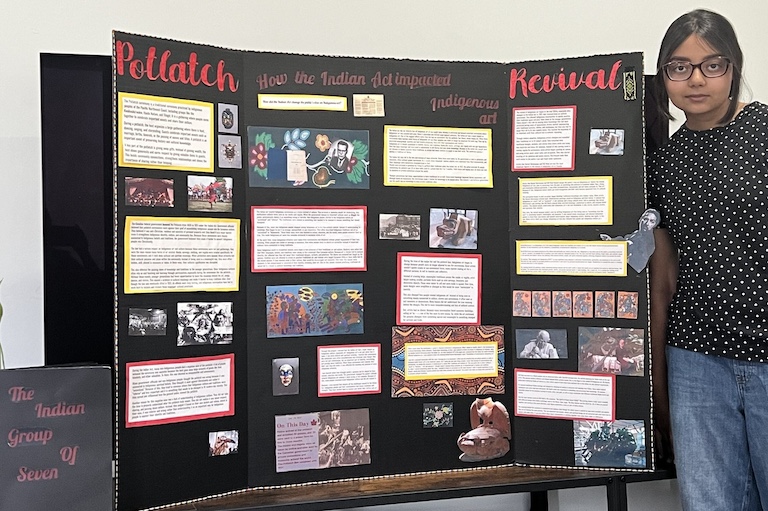
How the Indian Act impacted Indigenous art
Afia S.
Calgary Regional Heritage Fair
Calgary, AB
My project explored how the Indian Act affected Indigenous art and shaped the public’s perception of Indigenous culture. I researched important historical events such as the creation of the Indian Act in 1876, cultural restrictions placed on Indigenous communities, and the effects of residential schools and assimilation policies. The key people involved were Indigenous artists, communities, leaders, and survivors who continued protecting their traditions despite these challenges. Government officials who created and enforced the Indian Act also played a major role in shaping these events.
During my research, I learned that Indigenous art was not only used for beauty, but also for storytelling, spirituality, identity, and preserving culture. Many forms of Indigenous expression, including ceremonies and traditional practices, were discouraged or restricted, which influenced how Indigenous art was viewed by the public for many years.
In the end, I learned that the Indian Act greatly changed public attitudes towards Indigenous art by contributing to stereotypes and discrimination. However, Indigenous people continued to preserve their culture through resilience and artistic expression. Today, Indigenous art is increasingly respected and recognized as an important part of Canadian history and identity.
What sources and evidence did you consult for your project? What different perspectives did they provide on your topic?
For my project, I used a variety of sources including books, websites, interviews, documentaries, podcasts, artwork, and school resources. These sources helped me understand both the historical impact of the Indian Act and the experiences of Indigenous artists. I used books such as 21 Things You May Not Know About the Indian Act by Bob Joseph and Heart Berry Bling by Terese Marie Mailhot to learn about Indigenous experiences, discrimination, identity, and cultural suppression under the Indian Act. I also researched Indigenous artists such as Norval Morrisseau, Bill Reid, and Daphne Odjig through websites, interviews such as CBC News - Norval Morrisseau greets the art world, CBC Vancouver 1988 THEN & NOW with Bill Reid, the National Gallery of Canada - An Interview with Daphne Odjig, documentaries, and artwork.
Different sources provided different perspectives on my topic. Historical websites and encyclopedias helped me understand facts about the Indian Act, residential schools, and bans on ceremonies such as the potlatch. Interviews and documentaries gave me a more personal perspective by showing Indigenous artists speaking in their own words about their struggles, beliefs, and experiences in the art world. The documentary There Are No Fakes also showed how Indigenous artists continued facing exploitation and discrimination even after gaining recognition. In the CBC podcast Unreserved Indigenous artists discuss how Norval Morrisseau’s work helped shape identity and inspired future generations, showing the lasting impact of Indigenous art.
I also used the artwork The Indian In Transition by Daphne Odjig as an important source in my project. I believed this was a valuable source because it came directly from an Indigenous artist herself, which provided a more personal and authentic perspective on Indigenous experiences. Through her artwork, Odjig expressed emotions, struggles, identity, and the effects of colonization in a way that historical facts alone could not fully explain. Her perspective helped me better understand how Indigenous artists used art not only for creativity, but also as a form of storytelling, resilience, and cultural expression.
I also learned about organizations such as the Professional Native Indian Artists Inc. also known as the “Indian Group of Seven”, who worked to change how Indigenous art was viewed in Canada. These different perspectives helped me understand that Indigenous art is not only creative expressions, but also a form of identity, resistance, storytelling, and cultural survival.
What is the historical significance of your topic?
The Indian Act is historically significant because it greatly affected Indigenous people, cultures, and traditions across Canada for generations. In the short term, the act restricted many parts of Indigenous life, including ceremonies, governance, movement, education, and cultural expression. Indigenous communities were pressured to assimilate into Western society, and many traditional practices and forms of art were discouraged or suppressed. These policies affected Indigenous artists, families, and entire communities by causing cultural loss, discrimination, and the weakening of traditional knowledge and languages.
The long-term impacts are still visible today. Many Indigenous communities continue working to reclaim traditions, languages, and forms of artistic expression that were once threatened by assimilation policies and residential schools. Indigenous art was often misunderstood or treated as less valuable by the public, which contributed to stereotypes and prejudice that lasted for decades. However, despite these hardships, Indigenous people preserved their culture through resilience, storytelling, beadwork, carving, painting, dance, and oral traditions.
Over time, important changes began to take place. More people started recognizing the harm caused by the Indian Act and the importance of reconciliation and cultural preservation. Indigenous artists and communities have continued reclaiming their voices and educating others through their work. Today, Indigenous art is increasingly respected as an important part of Canadian history, identity, and culture. This topic is historically significant because it shows how government policies can affect culture and identity for generations, while also highlighting the resilience and strength of Indigenous people.
Why did you choose this topic?
At first, I wanted my project to focus only on Indigenous art because I was interested in learning about its beauty, symbolism, and cultural meaning. My interest in the topic first began in Grade 6 when I learned about Anishinaabe and researched about Norval Morrisseau and his artwork. I was inspired by the way he used bold colors, storytelling, and spirituality to express Indigenous identity and culture. Learning about his life and art made me more curious about Indigenous history and the experiences behind the artwork itself.
However, as I continued researching, I discovered many stories about cultural suppression and discrimination against Indigenous people. This made me wonder why Indigenous art and traditions were treated differently and why so many cultural practices had been discouraged or hidden throughout history. While discussing my ideas with my teacher, she introduced me to the Indian Act, which completely changed the direction of my project.
As I researched further, my heart sank as the realization set in that my own culture had experienced similar forms of suppression. In my home country, I noticed similar effects of westernization and colonization on my own culture and traditions. Traditional art and cultural practices were often viewed as old-fashioned or inferior. I remember visiting museums and seeing cultural artifacts displayed behind glass, yet I almost never saw people actively practicing or creating those traditions in everyday life.
My grandmother also shared stories with me about how some people became ashamed of traditional art and customs because society viewed them as strange, uncivilized, or less valuable. Hearing this made me realize how deeply words, stereotypes, and discrimination can affect an entire culture and its identity. It saddened me to learn that many cultures around the world experienced similar forms of suppression, including Indigenous communities in Canada.
This project became very important to me because I wanted to spread awareness about how harmful cultural discrimination can be and how important it is to respect and preserve traditions. Through my research, I learned that Indigenous art is more than decoration, it is a form of storytelling, identity, spirituality, and resilience. Despite the challenges created by the Indian Act and assimilation policies, Indigenous peoples continued protecting their culture through art, language, and tradition. I hope my project encourages others to appreciate cultural diversity and understand the importance of preserving heritage for future generations.