
Acadia E.
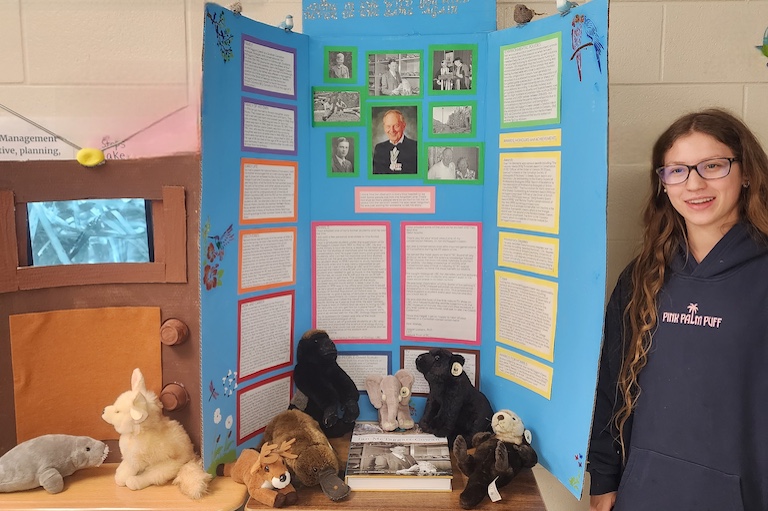
Ian McTaggart-Cowan
Acadia E.
Toronto District School Board Regional Heritage Fair
Toronto, ON
Ian McTaggart-Cowan was a pioneering biologist, educator, conservationist and television educator. Ian was born in Scotland, in 1910 and moved to Vancouver at the age of 3. Ian was a professor at UBC where he created the zoology department and supervised over 100 PhD students. Many of his students today are seen as the current environment, ecology and zoology experts in the field. Ian wrote over 200 academic publications and contributed to a 4 volume book of Birds of British Columbia. In honour of Ian’s contribution to environmental research a trust fund was created for zoology students at UBC.
Ian was a key voice in animal conservation and was involved in developing environmental organizations, government committees and led policy development including the banning of animal bounty hunting in Canada.
Ian made many discoveries including finding the Pacific Pallid Bat and the thought extinct Vancouver Island Marmot. Ian’s contributions have been acknowledged with 3 animals named after him: a triangle island vole, an amphipod and a species of marine mollusk. In addition, Ian won many awards, titles and honorary degrees including the Order of Canada.
Ian was the person behind bringing ecological content to television. He created 3 tv shows: Fur and Feathers; The Web of Life and The Living Sea. His show the Web of Life was the first to broadcast microscopic animals under a microscope. Ian’s show Fur and Feathers eventually became ‘The Nature of Things' that was run by David Suzuki who was hired by Ian.
Ian is known as the "forgotten one," but he doesn't need to be. So many people were so excited to tell me all about him the second I asked. He was never forgotten; he was just waiting for someone to tell his story. Because of his contributions to animals and the environment through education, research and TV his story needs to be told.
What sources and evidence did you consult for your project? What different perspectives did they provide on your topic?
I used primary and secondary sources. The primary sources include contacting and gathering first hand accounts from people who worked or studied under Ian. I also found CBC clips of his television shows. Secondary sources included obituaries, other people's biographies about him and articles written about him.
Connecting to people who knew him allowed me to learn more about his personality and what he was like as a person. The people who knew him were able to answer my questions the best. The secondary sources provided a basic overview of his career and life.
What is the historical significance of your topic?
The historical significance is that he was the first to do many things with ecology, biology, zoology, conservation, education and television in Canada. He was a trailblazer that paved the path for others in the field including David Suzuki and David Attenborough. The academic community was affected by his program development and thesis supervision. The general public benefited because he taught them through television and made environment and ecology topics interesting and accessible. He was a founder of many conservation organizations that still remain today including World Wildlife Fund. He also was a key voice in ending bounty hunting in Canada.
Why did you choose this topic?
I selected this person because he focused on things that I really enjoy and am interested in studying in university, specifically zoology.