
Abdulhaleem A.
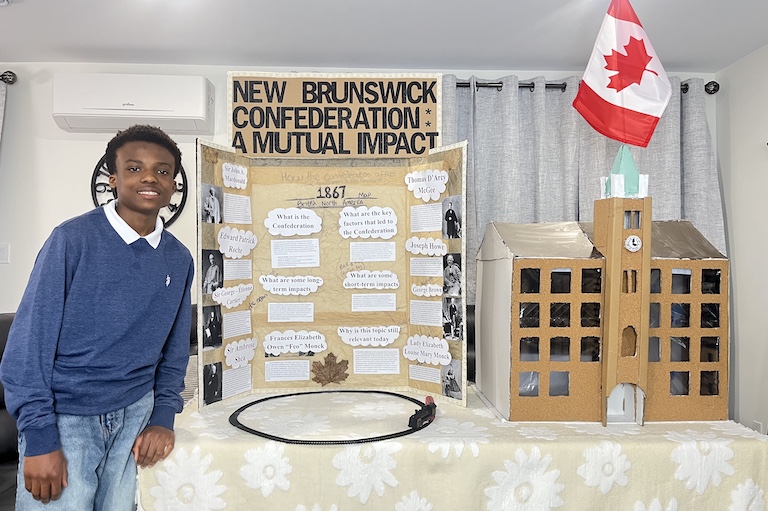
New Brunswick, Confederation: A Mutual Impact
Abdulhaleem A.
Anglophone East School District Regional Heritage Fair
Moncton, NB
My project explored the Canadian Confederation of 1867, with a special focus on how New Brunswick helped shape the decisions that led to the creation of the Dominion of Canada. Before Confederation, the colonies were facing serious problems: political deadlock between Upper and Lower Canada, economic instability, poor transportation, and growing fears of American expansion after the U.S. Civil War. These challenges pushed the colonies to consider uniting for stronger defense, better trade, and a more stable government.
The story of Confederation unfolded through three major conferences: the Charlottetown Conference, the Quebec Conference, and the London Conference. Thirty‑six delegates, now known as the Fathers of Confederation attended one or more of these meetings. Key figures included Sir John A. Macdonald, George‑Étienne Cartier, George Brown, Thomas D’Arcy McGee, and others who debated, negotiated, and shaped the foundations of the new country. Their work led to the unification of Ontario, Quebec, New Brunswick, and Nova Scotia in 1867, with other provinces joining in the years that followed.
My final response to my inquiry question is that New Brunswick played a crucial role in Confederation. It supported the idea of a united defense, encouraged economic cooperation through the Intercolonial Railway, and helped move the discussions forward at the conferences. Without New Brunswick’s involvement, the path to Confederation would have been far more difficult and Canada might not have formed the way it did.
What sources and evidence did you consult for your project? What different perspectives did they provide on your topic?
For my project, I used both primary and secondary sources. My primary sources came from the Canadian Museum of History and the Canadiana website, which gave me original documents and firsthand perspectives from the time of Confederation. My secondary sources included Britannica, The Canadian Encyclopedia, and the British North America Database. These helped me understand the events more clearly and showed how historians interpret Confederation from different angles. Using both types of sources gave me a balanced view of what happened and why it mattered.
What is the historical significance of your topic?
The Canadian Confederation of 1867 is historically significant because it created major short‑term and long‑term changes that shaped the country. In the short term, Confederation gave Canada a new federal government, helped the provinces work together, strengthened defense against the United States, and supported economic growth through better trade and transportation. These changes affected everyone living in the colonies by creating more stability and a stronger sense of unity, even though there were early challenges between different regions.
The long‑term impacts were even more important. Confederation established Canada’s federal system, balanced power between the national and provincial governments, and created Parliament with the House of Commons and the Senate. Over time, this system allowed Canada to expand, govern itself more independently, and grow into the country it is today. In simple words, the short‑term impact was improved cooperation and stability, and the long‑term impact was the creation of Canada’s lasting government structure and national identity.
Why did you choose this topic?
I chose this topic because it felt unique and often overlooked. In most history competitions, people usually focus on subjects like Indigenous history, Black history, or enslavement, and I could have chosen those too, especially since I’m Black myself and already familiar with those stories. But I wanted to challenge myself and explore something different, something that goes back to the roots of how the Dominion of Canada was formed. To help myself understand it better, I imagined a room full of leaders debating the future of the land we now call Canada. In that room, New Brunswick wasn’t just sitting quietly. It played a major role in shaping the decisions that led to Confederation in 1867. That image helped me see how important this moment was, and why it still matters today.